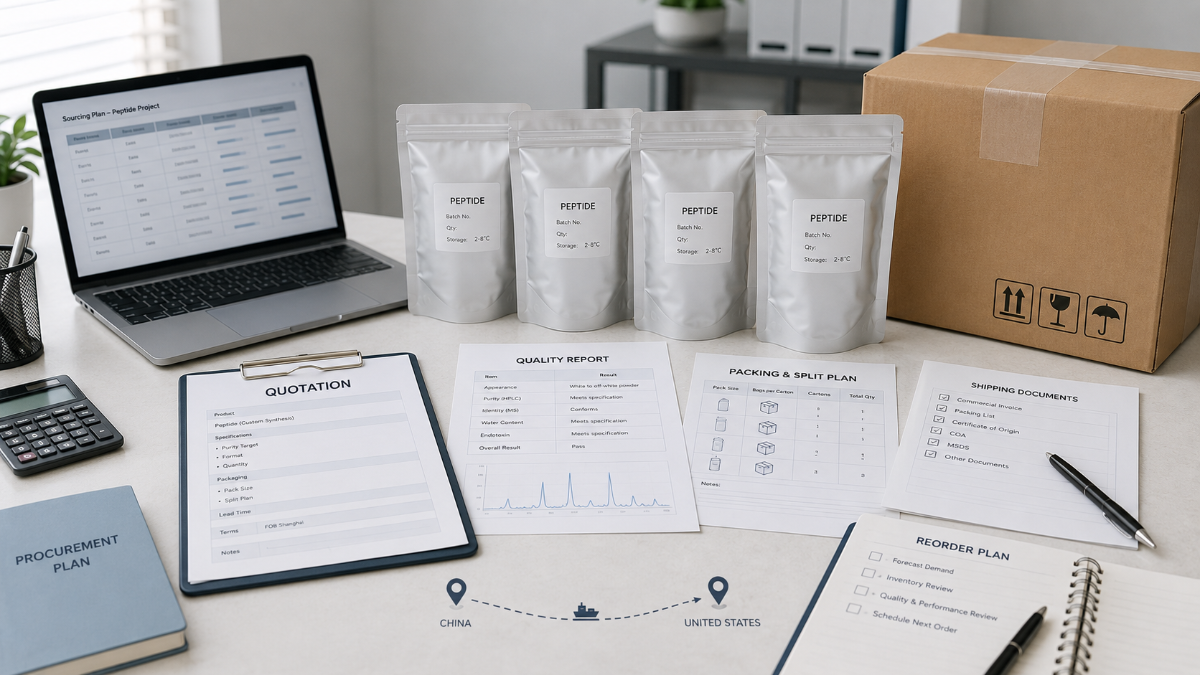
What Business Buyers Should Know Before Ordering Peptides in Bulk?
Bulk peptide purchasing can lower unit costs and support business growth. Yet a larger order also increases the cost of unclear specifications, weak documentation, unsuitable packaging, and poor supply planning.
Before ordering peptides in bulk, business buyers should confirm product specifications, analytical documentation, batch traceability, packaging format, storage conditions, preparation time, shipping options, regulatory fit, and repeat-order capability.
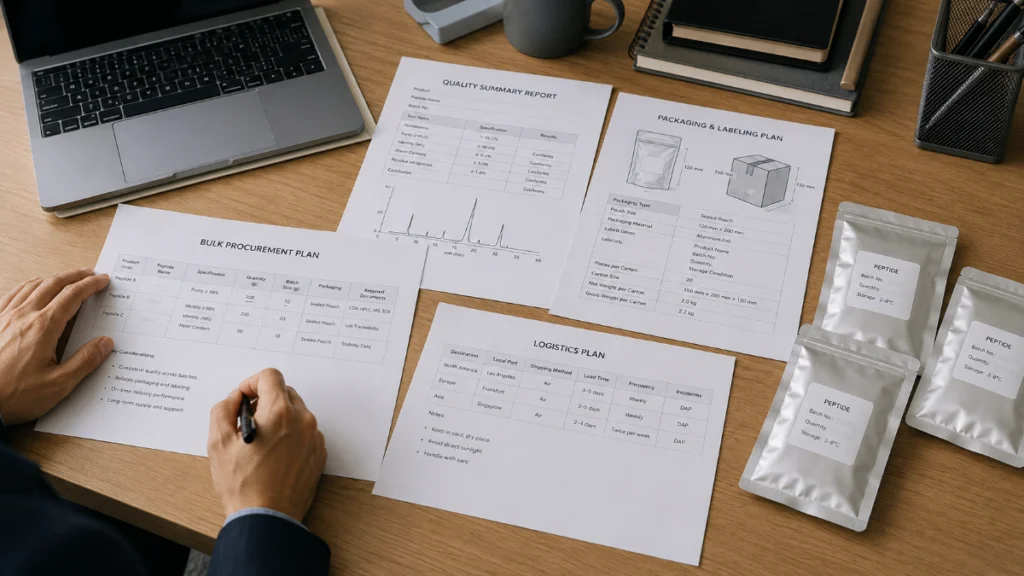
At MoxPeptide, we work with cosmetic brands, research laboratories, distributors, and biotech companies that need reliable peptide supply at different stages of growth.
Some buyers begin with a small quantity for formulation testing or internal review. Later, they need a larger order. Other buyers already have a mature purchasing plan and need wholesale quantities from the beginning.
Bulk purchasing is not simply a larger version of a small order.
The risk profile changes as the quantity grows.
A minor misunderstanding about purity, packaging, or delivery can be manageable during a small qualification order. The same misunderstanding can become expensive when the purchase moves to a larger scale.
For this reason, we believe bulk sourcing should begin with a clear purchasing framework.
Based in Xi’an, China, MoxPeptide helps global buyers coordinate qualified manufacturing resources, analytical documentation, packaging, logistics, international communication, and repeat-order planning.
Our goal is not only to deliver peptides. Our goal is to make bulk sourcing easier to understand and easier to manage.
What Should Buyers Look for When Purchasing Peptides in Bulk?
A low unit price can look attractive. Yet unit price alone does not show whether a bulk order will support the buyer’s real business needs.
When purchasing peptides in bulk, buyers should review product fit, quality evidence, batch traceability, packaging, storage, lead time, shipping, regulatory fit, and long-term supply capability.
We recommend starting with the intended application.
A cosmetic brand purchasing GHK-Cu or Acetyl Hexapeptide-8 may focus on formulation consistency, repeat-order planning, and wholesale packaging.
A research laboratory may focus more on sequence accuracy, purity data, and analytical documentation.
A distributor may need a broader product range, flexible pack sizes, stable logistics, and clear inventory planning.
A biotech company may need custom synthesis, modifications, feasibility review, and a path toward scale-up.
The correct bulk purchasing plan depends on the buyer’s real use case.
Bulk Peptide Purchasing Checklist
| Area | What Buyers Should Confirm | Why It Matters |
|---|---|---|
| Product Identity | Peptide name, sequence, molecular formula, molecular weight | The supplied material must match the project requirement. |
| Purity Target | Required purity specification and supporting HPLC data | The buyer needs a measurable quality standard. |
| Molecular Identity | Available MS data whenever applicable | The buyer needs supporting evidence for peptide identity. |
| Quantity | Total quantity, MOQ, pack size, and future demand | Bulk quantities should fit the actual purchasing plan. |
| Batch Traceability | Batch number, test date, and linked records | Documents should relate clearly to the supplied material. |
| Packaging | Container type, sealing method, pack size, and labeling | Packaging affects receiving, handling, and storage. |
| Storage | Recommended temperature and handling conditions | The buyer needs to protect product stability. |
| Preparation Time | Availability, production schedule, and testing timeline | Bulk orders require realistic planning. |
| Shipping | Available methods, estimated transit time, and tracking | Logistics should fit the buyer’s destination and timeline. |
| Repeat Supply | Future availability and scale-up capability | A successful project may require ongoing purchasing. |
At MoxPeptide, we use these questions to build a practical sourcing plan.
We do not treat every inquiry as a request for a price list.
We ask about the peptide, quantity, destination country, target purity, intended use, documentation requirements, packaging preference, and future purchasing needs.
This helps us coordinate a bulk order that fits the buyer’s project rather than sending a generic quotation.
Why Is Bulk Peptide Ordering Different From a Sample Order?
A sample order helps buyers test a supplier. A bulk order creates a deeper operational commitment.
Bulk peptide ordering requires stronger control over specifications, batch consistency, packaging, storage, logistics, and repeat-order planning because larger quantities increase both financial exposure and supply-chain risk.
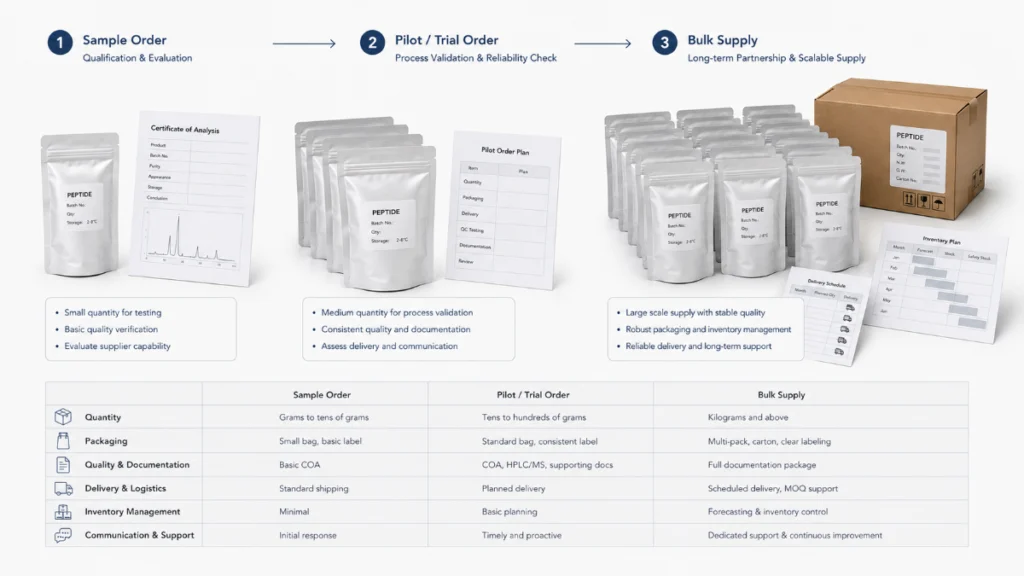
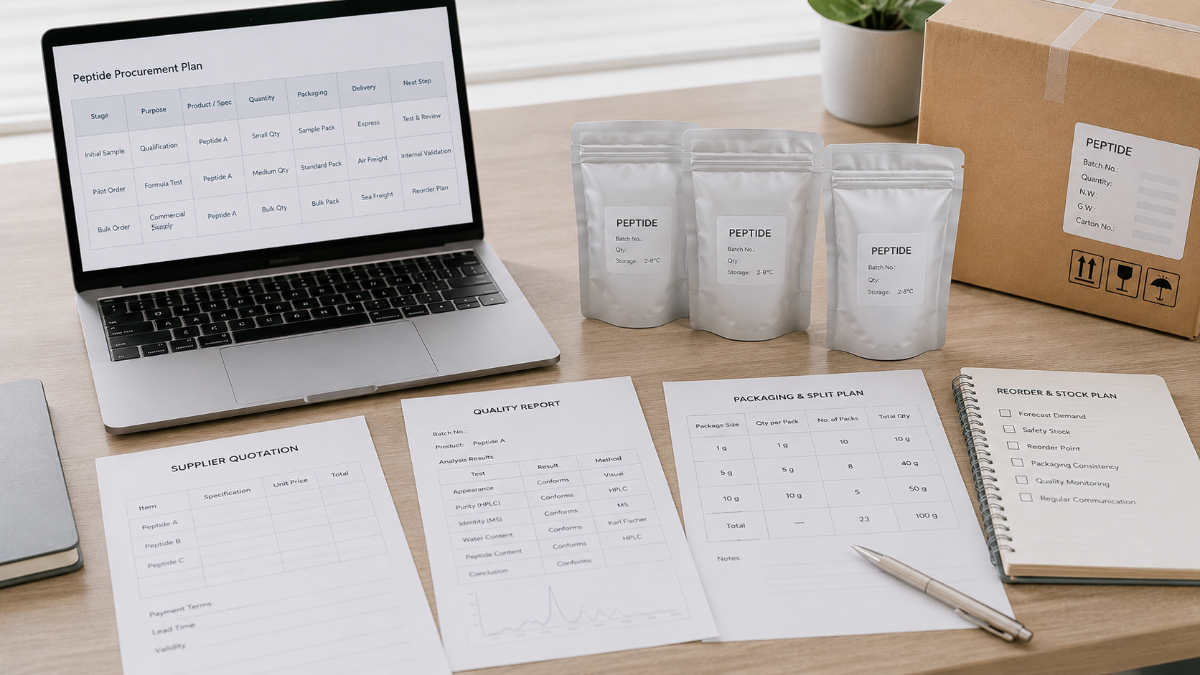
We recommend separating three purchasing stages:
- Qualification order
- Pilot or intermediate order
- Bulk order
A qualification order helps the buyer review product quality, documentation, packaging, communication, and delivery performance.
A pilot order helps the buyer test whether the supplier can support a larger operational workflow.
A bulk order supports ongoing business needs.
The buyer should not assume that a successful small order automatically answers every question about a larger purchase.
A bulk order may require different packaging. It may involve a longer preparation timeline. It may need batch allocation planning. It may also require more detailed receiving procedures and inventory control.
Sample Orders and Bulk Orders Serve Different Purposes
| Order Type | Main Purpose | What Buyers Should Review |
|---|---|---|
| Qualification Order | Initial supplier validation | Product, documents, packaging, communication, delivery |
| Pilot Order | Operational testing | Repeatability, handling, internal workflow, larger quantity readiness |
| Bulk Order | Ongoing business supply | Batch planning, packaging structure, storage, logistics, reorder strategy |
At MoxPeptide, we help buyers move through these stages with a clear plan.
Some buyers need a small quantity first. Others already have internal testing results and need a larger order.
The key is not starting small or starting large.
The key is choosing the purchasing stage that matches the project.
Where Do Companies Get Their Peptides From?
Many buyers assume that every peptide supplier operates in the same way. In reality, companies source peptides through several different supply models.
Companies may source peptides directly from specialized manufacturers or work with distributors, exporters, and professional supply partners that coordinate production, quality documentation, packaging, logistics, and communication.
We believe buyers should understand the difference between product access and supply-chain execution.
A supplier may have access to a broad peptide catalog. That does not automatically mean the supplier has a strong process for managing analytical documents, packaging requirements, delivery planning, and repeat orders.
A direct manufacturer may provide close production access.
A distributor may offer regional convenience.
An exporter may help with cross-border communication.
A professional supply partner can connect manufacturing resources with the buyer’s full purchasing workflow.
Common Peptide Supply Models
| Supply Model | Main Strength | What Buyers Should Review |
|---|---|---|
| Direct Manufacturer | Production access and technical discussion | Communication, documentation, logistics, and customer support |
| Distributor | Regional inventory and convenience | Traceability, product origin, and repeat availability |
| Export Partner | Cross-border communication and logistics | Technical coordination and document management |
| Basic Trading Company | Broad catalog access | Actual value added beyond forwarding quotations |
| Professional Supply Partner | End-to-end sourcing coordination | Manufacturing resource qualification and execution quality |
At MoxPeptide, we operate as a professional B2B peptide supply partner.
We connect global buyers with qualified manufacturing resources while coordinating available analytical documentation, packaging, logistics, and international communication.
This matters because bulk purchasing involves more than production.
A business buyer needs a supply partner who can help connect each stage of the process.
What Documents Should Buyers Request Before a Bulk Peptide Order?
A purity claim can look convincing on a quotation. Yet a bulk purchasing decision should be supported by useful records.
Before placing a bulk peptide order, buyers should review available COA, HPLC reports, MS reports, SDS documents, product specifications, packaging information, and batch-specific records whenever applicable.
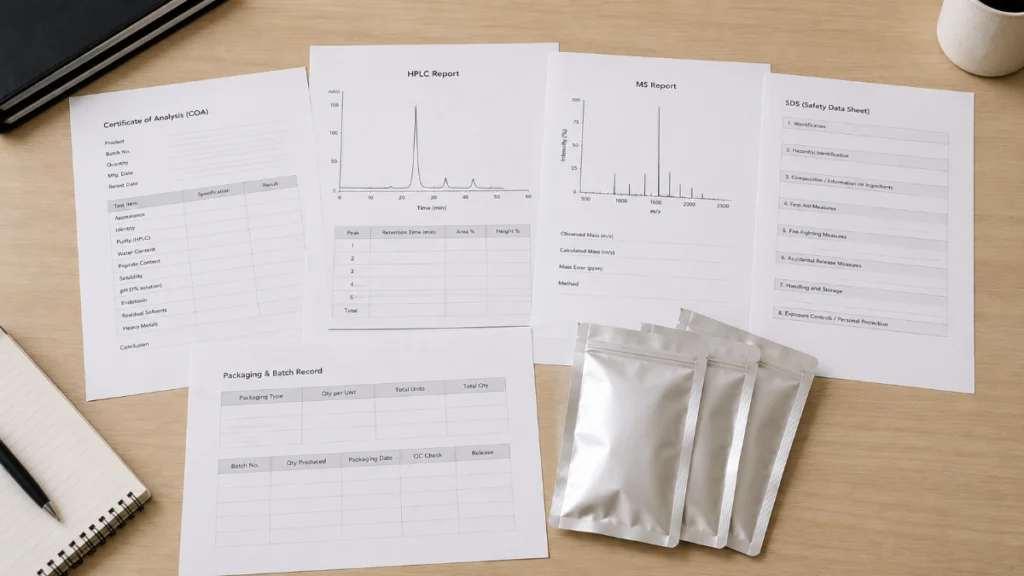
At MoxPeptide, we treat documentation as a core part of bulk sourcing.
A COA gives the buyer a summary of reported results.
An HPLC report helps the buyer review the purity profile.
An MS report helps support molecular identity review.
An SDS supports handling and storage planning.
A product specification helps define the target standard.
Packaging information helps the buyer prepare for receiving and inventory management.
Batch-specific records help connect the supplied material with the relevant reports whenever applicable.
Essential Bulk Order Documents
| Document | What It Helps Buyers Review | Key Details |
|---|---|---|
| COA | Product and batch summary | Product name, batch number, purity result, test date |
| HPLC Report | Purity profile | Reported purity, main peak, secondary peaks, test date |
| MS Report | Molecular identity support | Expected and observed molecular mass |
| SDS | Handling and storage | Recommended conditions and safety guidance |
| Product Specification | Agreed target standard | Appearance, grade, purity target, relevant details |
| Packaging Information | Receiving preparation | Container type, seal, pack size, labeling |
| Batch Records | Traceability | Batch reference and linked documents |
| Custom Synthesis Summary | Project-specific requirements | Sequence, modifications, scale, target purity, timeline |
We also recommend distinguishing between representative documents and shipment-specific records.
Representative documents can help a buyer review the supplier’s documentation format during early discussions.
Shipment-specific records help the buyer connect the delivered material with the relevant production batch.
At MoxPeptide, our role is not limited to forwarding attachments.
We help buyers understand which records are available, how they relate to the order, and what still needs confirmation before shipment.
How Should Buyers Evaluate Peptide Quality Before Ordering in Bulk?
A single purity number is useful. Yet it does not explain the complete quality picture.
Before ordering peptides in bulk, buyers should evaluate product identity, HPLC purity data, MS results, batch traceability, packaging, storage guidance, and repeat-order consistency.
We recommend reviewing peptide quality in layers.
Each layer answers a different question.
HPLC helps review the purity profile.
MS helps support molecular identity review.
The COA summarizes the reported results.
Batch references help connect the documentation with the supplied material.
Packaging and storage information help protect the peptide after dispatch.
Repeat-order records help the buyer understand whether future orders can meet the same agreed requirements.
Bulk Peptide Quality Review Framework
| Quality Area | What Buyers Should Review | Main Question |
|---|---|---|
| Product Identity | Peptide name, sequence, molecular formula, molecular weight | Is this the intended peptide? |
| Purity | HPLC report and target specification | Does the material meet the required purity level? |
| Molecular Identity | MS report whenever applicable | Do the observed results support the expected peptide identity? |
| Traceability | Batch number, test date, linked documents | Can the supplied material be connected to the records? |
| Packaging | Container, sealing method, quantity per pack | Will the material arrive in suitable condition? |
| Storage | Recommended temperature and handling | Can the buyer protect product stability after delivery? |
| Consistency | Repeat-order expectations and agreed specification | Can future orders follow the same standard? |
At MoxPeptide, we do not assume that every buyer needs the same specification.
We begin by understanding the application.
A cosmetic peptide project may focus on formulation consistency and stable wholesale supply.
A research peptide order may require stronger attention to analytical records and sequence accuracy.
A custom peptide project may involve modifications, feasibility review, scale-up planning, and technical coordination.
The correct quality review process depends on the project.
Why Does Packaging Matter for Bulk Peptide Orders?
Packaging is often treated as a minor detail. For bulk purchasing, it can affect handling, storage, inventory control, and operational efficiency.
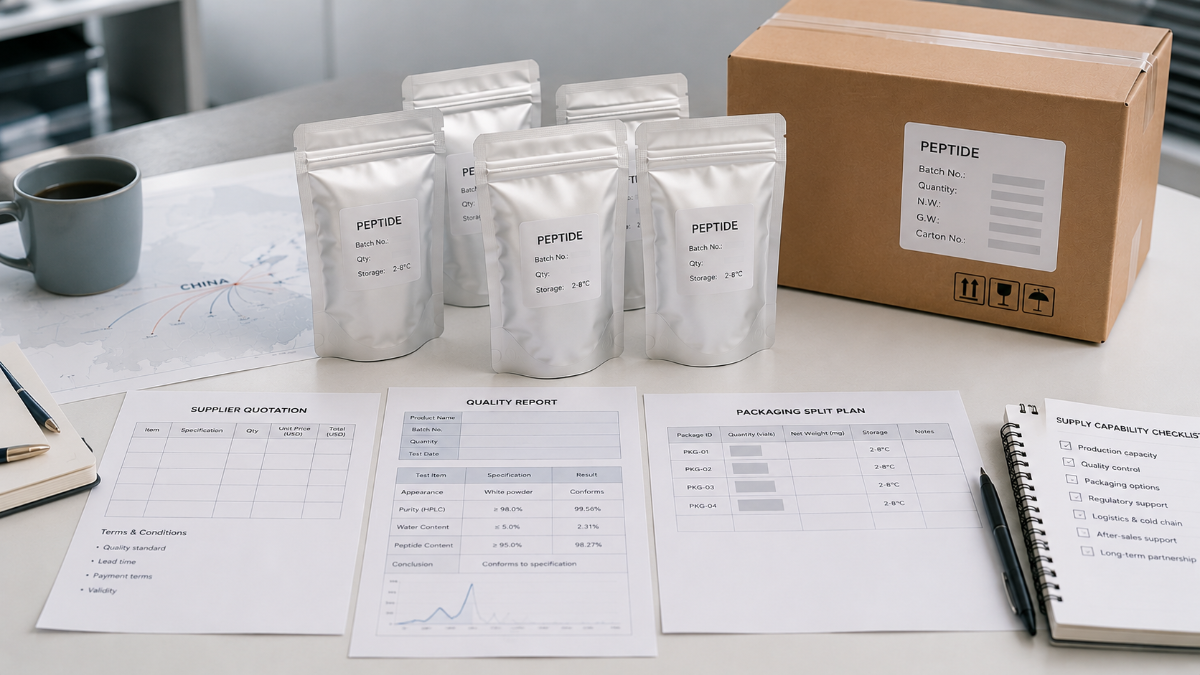
Bulk peptide packaging should be planned around the buyer’s receiving process, storage conditions, pack-size needs, contamination risk, and future usage pattern.
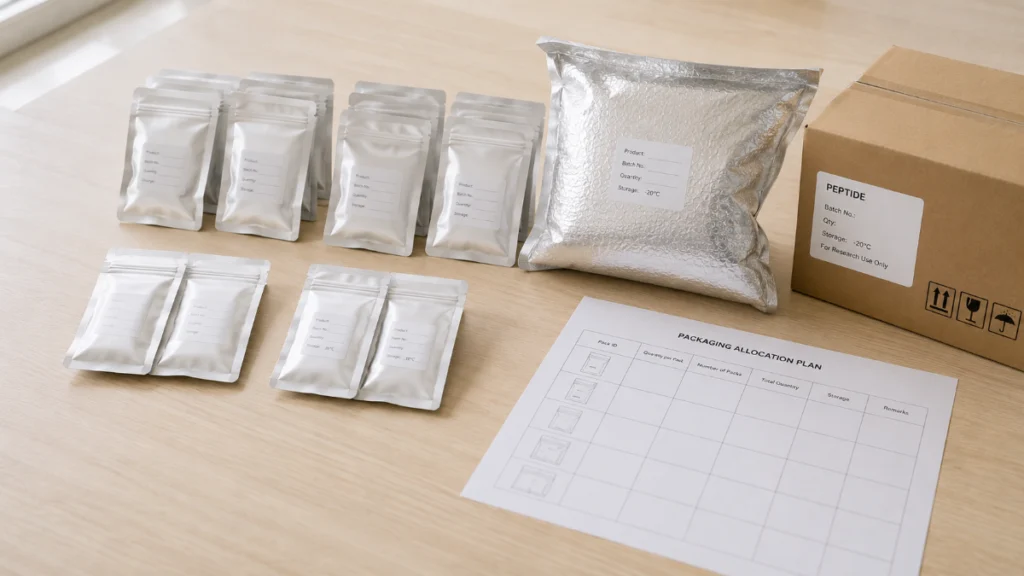
We recommend discussing packaging before shipment.
A large quantity does not always need to be packed in one large container.
A cosmetic brand may prefer several sealed packs that fit formulation batches.
A research laboratory may need smaller quantities for controlled internal use.
A distributor may need pack sizes that support inventory planning.
A biotech company may need packaging that matches different development stages.
Bulk Packaging Questions Buyers Should Ask
| Question | Why It Matters |
|---|---|
| How much peptide will be placed in each container? | Pack size affects internal handling and inventory planning. |
| Can a larger order be split into smaller sealed packs? | Split packaging may reduce repeated opening and handling. |
| What type of container will be used? | The buyer needs to plan storage and receiving. |
| How will the container be sealed? | Sealing affects product protection. |
| What information will appear on the label? | Buyers need clear product identification and traceability. |
| What storage conditions are recommended? | Storage planning should begin before delivery. |
| Will packaging change for larger future orders? | Buyers need consistency across repeat purchases. |
At MoxPeptide, we coordinate packaging based on the buyer’s purchasing plan.
We believe packaging should support the buyer’s workflow rather than create extra work after delivery.
How Should Buyers Calculate the Real Cost of a Bulk Peptide Order?
The lowest price per gram is not always the lowest total cost.
Business buyers should calculate the real cost of a bulk peptide order by reviewing product price, documentation quality, packaging, shipping, internal handling, quality risk, delivery reliability, and repeat-order efficiency.
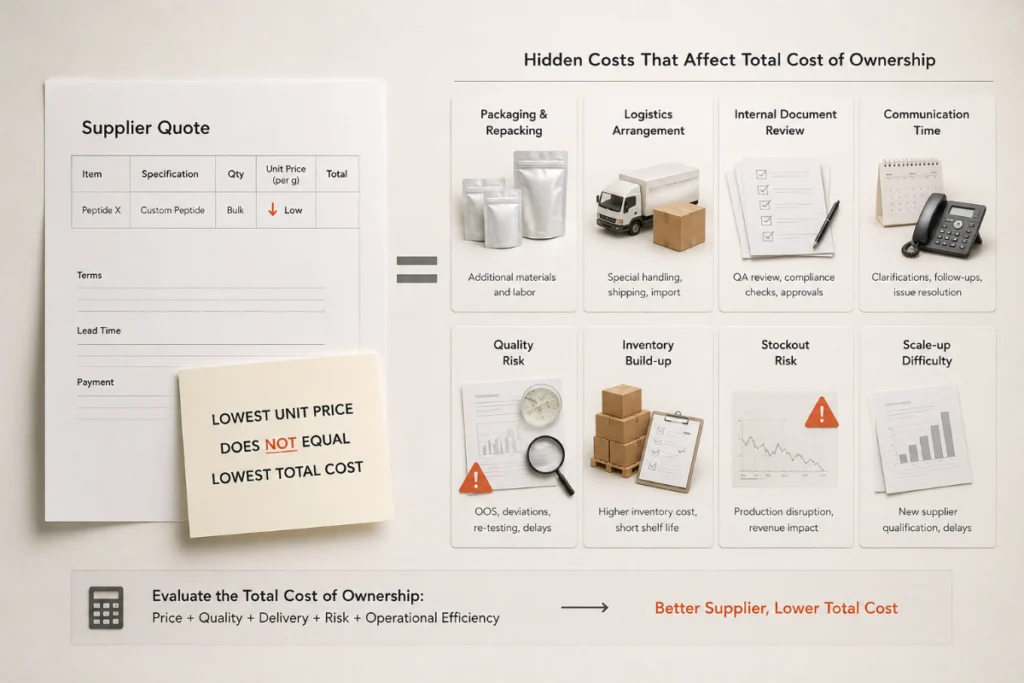
We recommend looking beyond the quotation total.
A lower unit price may look attractive. Yet unclear documentation can create internal delays. Poor packaging can create receiving problems. Weak communication can waste procurement time. An unreliable delivery plan can disrupt project timelines.
The real purchasing cost includes both visible and hidden costs.
Visible and Hidden Bulk Purchasing Costs
| Cost Area | Example |
|---|---|
| Product Cost | Price per gram and total order value |
| Packaging Cost | Container type, split packaging, sealing, labeling |
| Logistics Cost | Shipping method, transit time, destination requirements |
| Documentation Cost | Internal time spent reviewing unclear or incomplete records |
| Communication Cost | Time spent resolving avoidable misunderstandings |
| Quality Risk Cost | Retesting, replacement, delays, or project disruption |
| Inventory Cost | Storage, reorder timing, unused stock, stockout risk |
| Scale-Up Cost | Problems that appear when order quantities increase |
At MoxPeptide, we aim to reduce the hidden costs of international sourcing.
We coordinate product information, documentation, packaging, and logistics before shipment.
This gives buyers a clearer view of the full purchasing process.
How Should Buyers Plan Repeat Bulk Orders?
A successful bulk order should not be treated as an isolated event. Buyers should consider the next order before the first large shipment is completed.
Repeat bulk ordering requires demand forecasting, reorder timing, batch planning, documentation consistency, packaging continuity, and clear communication about future quantities.
We recommend discussing future demand early.
A cosmetic brand may need stable wholesale quantities every few months.
A distributor may need inventory planning across several peptides.
A research laboratory may need the same peptide again after internal validation.
A biotech company may need a larger custom synthesis order after feasibility testing.
The supplier should understand the likely direction of the project.
Repeat-Order Planning Questions
| Question | Why It Matters |
|---|---|
| What quantity may be needed next? | Future demand affects supply planning. |
| When should the next order be placed? | Reorder timing reduces stockout risk. |
| Will the same specification apply? | Buyers need clarity across repeat orders. |
| Will packaging remain the same? | Packaging continuity supports internal workflow. |
| Will future orders require new batch documentation? | Buyers need repeat-order traceability. |
| Could demand increase significantly? | Scale-up may require a different preparation plan. |
| Does the buyer need a backup plan? | Supply continuity matters for important projects. |
At MoxPeptide, we focus on repeat-order support rather than one-time transactions.
We help buyers move from qualification orders to larger purchasing plans with greater clarity.
Do Buyers Need a License to Sell Peptides?
There is no single universal license that applies to every peptide business. The correct answer depends on the intended use, product classification, business activity, and destination market.
Whether a buyer needs a license, registration, listing, approval, or other regulatory review depends on how the peptide will be used, marketed, imported, distributed, or incorporated into a finished product.
We recommend treating regulatory fit as a project-specific question.
A peptide sold as a cosmetic ingredient raises different questions from a finished skincare product.
A research material raises different questions from a finished product marketed for human use.
A product marketed as a drug in the United States raises a different set of requirements.
For the U.S. market, the FDA explains that the intended use and claims made for a product can affect whether it is considered a cosmetic, a drug, or both. Buyers can review the FDA’s official guidance: Is It a Cosmetic, a Drug, or Both?
The FDA also explains that drug companies seeking to sell a drug in the United States generally submit evidence for FDA review before the drug can be approved for sale. The FDA’s official overview is available here: Development & Approval Process | Drugs
Cosmetic products and ingredients usually follow a different pathway. The FDA explains that cosmetics and cosmetic ingredients generally do not require premarket approval, except for color additives: FDA Authority Over Cosmetics
The Modernization of Cosmetics Regulation Act of 2022 (MoCRA) also expanded FDA’s authority over cosmetics and introduced additional requirements in applicable situations.
Regulatory Questions Business Buyers Should Ask
| Question | Why It Matters |
|---|---|
| What is the intended use of the peptide? | Product classification may depend on the real application. |
| Will the buyer sell an ingredient or a finished product? | Different business models may involve different requirements. |
| Which country will receive the product? | Rules vary by destination market. |
| What claims will appear in marketing materials? | Claims may affect product classification. |
| Will the peptide be imported, distributed, formulated, or resold? | Business activities may affect the regulatory review. |
| What documents are available? | Buyers may need records for internal and external review. |
| Does the buyer need professional regulatory advice? | Qualified advisors should review project-specific questions. |
At MoxPeptide, we ask buyers to clarify intended use and destination market early in the discussion.
We coordinate available product information and documentation.
We also recommend that buyers confirm regulatory suitability with qualified advisors and relevant authorities for their specific application.
Clear sourcing requires accurate information, not broad promises.
What Should U.S. Buyers Know About Importing Bulk Peptides?
Cross-border purchasing requires planning. U.S. buyers should review product classification, documentation, and import requirements before shipment.
U.S. buyers should confirm how the peptide is classified, which records are needed, how the product will be described, and whether the shipment meets the requirements that apply to its intended use.
The correct import process depends on the product.
The FDA explains that products regulated by the agency must meet the same requirements whether they are imported or produced domestically: FDA Import Program
For cosmetic products, the FDA provides a dedicated overview: Importing Cosmetics
The FDA states that cosmetics offered for import into the United States must comply with the same FDA laws and regulations as cosmetics produced in the United States.
U.S. Customs and Border Protection also provides general information for businesses that import goods: Basic Importing and Exporting
Import Planning Questions
| Question | Why It Matters |
|---|---|
| How is the product classified? | Product classification affects the review process. |
| What is the intended use? | The intended use should match the product description and documentation. |
| Which documents should accompany the shipment? | Buyers need a complete receiving and import plan. |
| How will the shipment be described? | Clear descriptions reduce avoidable confusion. |
| What packaging and labeling will be used? | Packaging should support traceability and receiving. |
| Who will coordinate the shipment? | Buyers need a clear point of contact. |
| Does the buyer need a customs broker or regulatory advisor? | Professional support may be useful for project-specific questions. |
At MoxPeptide, we coordinate shipping options, packaging details, and available documentation with buyers before dispatch.
We believe that logistics planning should begin before the order is ready to ship.
What Are the Most Reputable Peptide Vendors?
There is no single supplier that fits every buyer, product, or market.
The most reputable peptide vendors consistently provide suitable products, relevant analytical documentation, traceable records, responsive communication, realistic planning, and dependable repeat-order support.
We recommend evaluating suppliers based on execution rather than marketing claims.
A supplier may describe itself as the best company in the market. That statement does not help a procurement team make a decision.
Buyers need practical evidence.
Reputable Bulk Peptide Supplier Checklist
| Indicator | Why It Matters |
|---|---|
| Clear Product Information | Buyers need the correct peptide and specification. |
| Relevant Analytical Reports | Buyers need evidence behind quality claims. |
| Traceable Records | Buyers need to connect documents with supplied material. |
| Suitable Packaging | Buyers need a practical receiving and storage plan. |
| Realistic Timelines | Buyers need dependable preparation and shipping estimates. |
| Responsive Communication | International sourcing requires clear coordination. |
| Flexible Quantities | Projects may move from testing to wholesale purchasing. |
| Repeat-Order Support | Business buyers need long-term continuity. |
| Technical Coordination | Buyers need support when questions require internal review. |
| Regulatory Awareness | Buyers need accurate communication about intended use and market fit. |
At MoxPeptide, we build our service around these requirements.
We do not believe that trust is created through one claim on a website.
We believe trust develops through clear information, organized documentation, realistic coordination, and consistent support across repeat orders.
How Should Buyers Place a Qualification Order Before Buying in Bulk?
A qualification order helps buyers review real supplier performance before increasing purchasing volume.
Before placing a bulk peptide order, buyers should consider a qualification order that tests product quality, documentation, packaging, communication, and delivery performance.
We recommend choosing a first order that fits the project.
The order should be large enough for meaningful internal review.
It should also remain manageable enough to limit unnecessary exposure.
During the qualification order, buyers should review more than the peptide itself.
They should check how the supplier confirms the product specification.
They should review the available documents.
They should check packaging, labeling, sealing, communication, dispatch timing, and tracking updates.
Qualification Order Review Checklist
| Review Area | What Buyers Should Check |
|---|---|
| Product | Does the material match the agreed requirement? |
| Documentation | Are the available records clear and organized? |
| Traceability | Can the product be linked to relevant records? |
| Packaging | Is the product sealed, labeled, and packed appropriately? |
| Communication | Are updates clear and timely? |
| Delivery | Does the actual timeline match the agreed plan? |
| Repeat Supply | Can the supplier support the next purchasing stage? |
At MoxPeptide, we support buyers from the first inquiry through qualification, bulk ordering, and repeat purchasing.
We aim to make each stage clear.
What Makes a Bulk Peptide Supply Partner Suitable for Long-Term Cooperation?
A supplier may complete one large order successfully. A long-term supply partner must also support the buyer as the project changes.
A suitable bulk peptide supply partner provides stable quality, organized documentation, flexible quantities, practical packaging, responsive communication, realistic planning, and dependable repeat-order coordination.
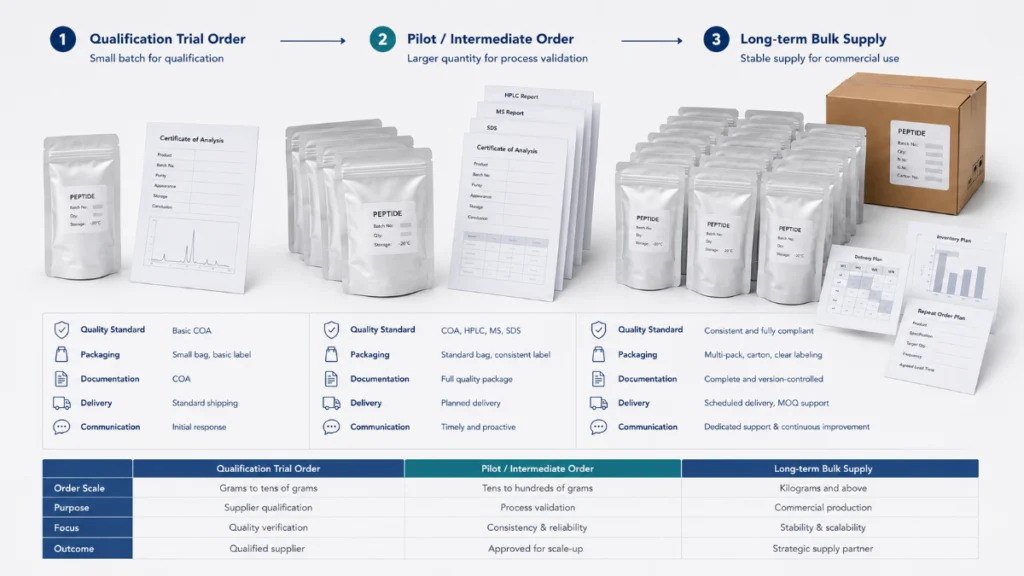
We believe that the most important question is:
Can this supplier support the next stage of the project?
A cosmetic brand may begin with formulation testing and later require regular wholesale quantities.
A distributor may add more products and need better inventory planning.
A research laboratory may move from one peptide to several related products.
A biotech company may move from feasibility review to larger custom synthesis orders.
The supplier should be ready to support that development.
Long-Term Bulk Supply Indicators
| Indicator | Why It Matters |
|---|---|
| Stable Quality | It reduces business risk. |
| Consistent Documentation | It supports internal review and repeat purchasing. |
| Flexible Quantities | It supports qualification, pilot, wholesale, and scale-up needs. |
| Practical Packaging | It supports receiving, storage, and inventory control. |
| Responsive Communication | It reduces friction during international sourcing. |
| Realistic Planning | It reduces avoidable delays. |
| Technical Coordination | It supports changing project requirements. |
| Repeat-Order Support | It improves supply continuity. |
At MoxPeptide, this is the role we aim to play.
Based in Xi’an, China, we connect global buyers with qualified peptide manufacturing resources while coordinating available analytical documentation, packaging, logistics, international communication, and long-term supply planning.
We do not treat a bulk order as the end of the process.
We treat it as part of a reliable working relationship.
Useful Official Resources for U.S.-Market Review
The following official resources can support internal review for projects involving the United States:
| Official Resource | When It Is Useful |
|---|---|
| FDA: Is It a Cosmetic, a Drug, or Both? | Helps buyers understand how intended use and claims may affect product classification. |
| FDA: Development & Approval Process for Drugs | Explains the U.S. drug development and approval process. |
| FDA: Drug Approvals and Databases | Helps buyers review U.S. drug approval information. |
| FDA: Authority Over Cosmetics | Explains how cosmetic products and ingredients are regulated. |
| FDA: Modernization of Cosmetics Regulation Act of 2022 | Explains the expanded U.S. cosmetics framework. |
| FDA: Registration and Listing of Cosmetic Product Facilities and Products | Helps buyers review registration and listing information for cosmetic projects. |
| FDA: Import Program | Explains that imported FDA-regulated products must meet applicable U.S. requirements. |
| FDA: Importing Cosmetics | Provides an overview for cosmetics offered for import into the United States. |
| CBP: Basic Importing and Exporting | Provides general U.S. customs information for commercial importers. |
| FDA: Is It Really “FDA Approved”? | Helps buyers distinguish product approval from registration, listing, and similar concepts. |
| FDA: National Drug Code Directory | Explains that assignment of an NDC number does not in itself mean FDA approval. |
These resources are useful starting points. They do not replace project-specific legal, regulatory, or customs advice.
Conclusion
Bulk peptide purchasing requires more than comparing prices.
At MoxPeptide, we help global buyers coordinate product fit, quality documentation, packaging, logistics, regulatory awareness, and repeat-order planning so that bulk sourcing can move forward with greater confidence.