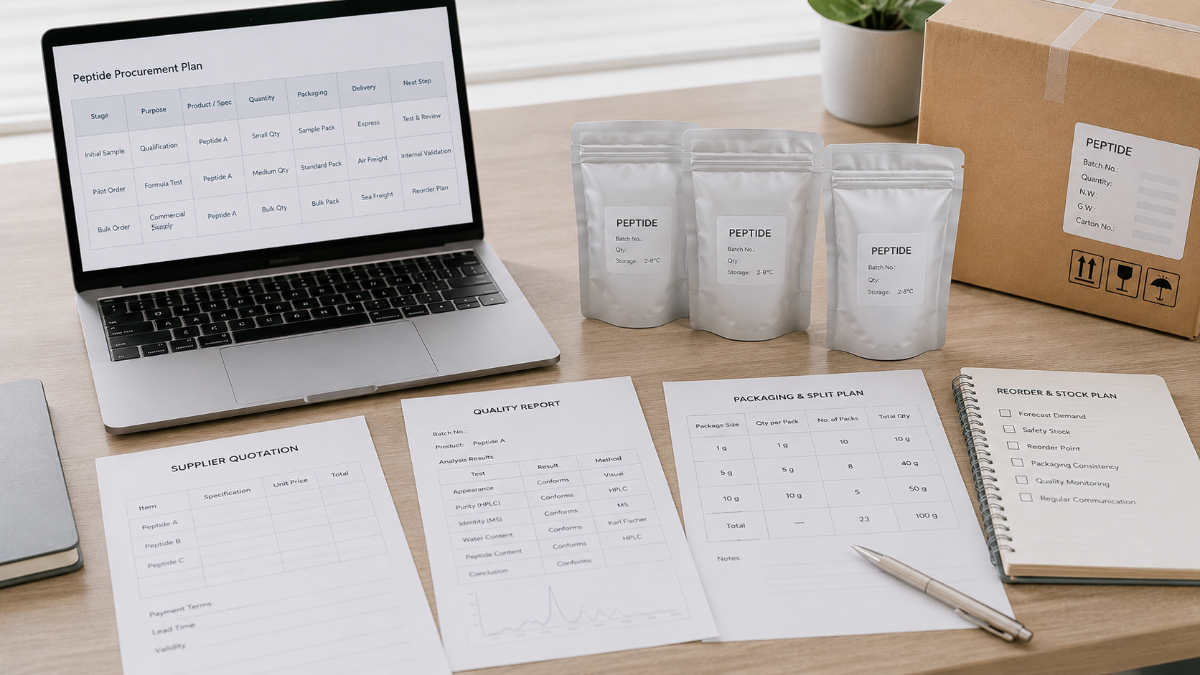
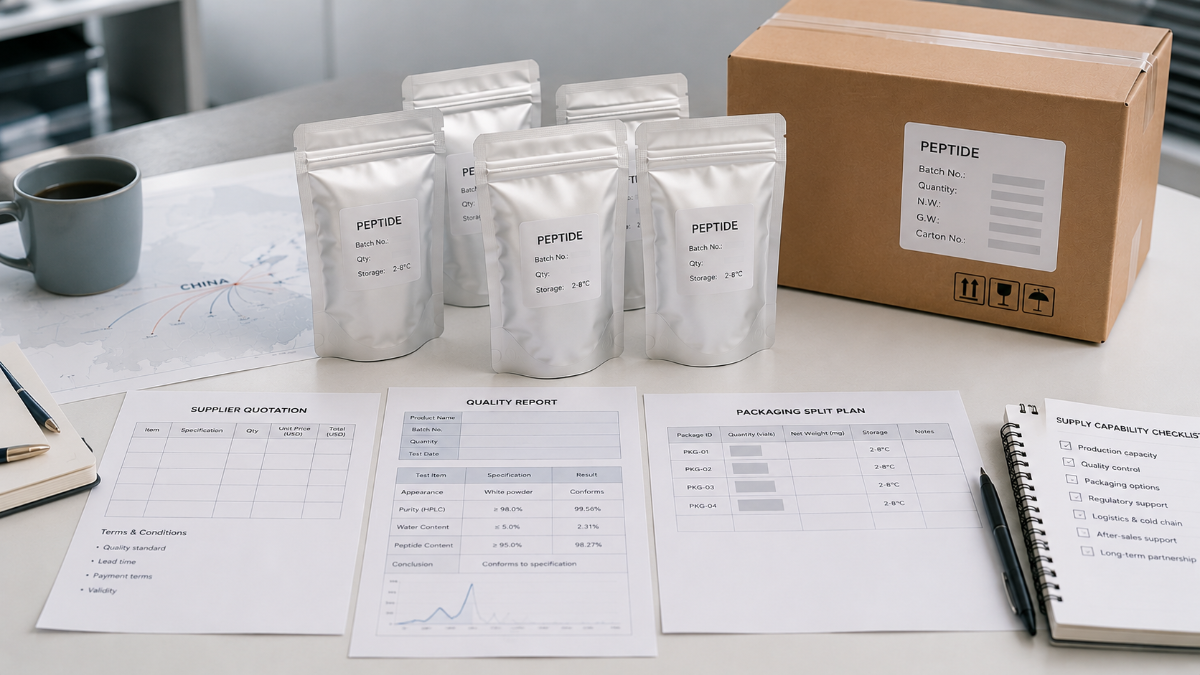
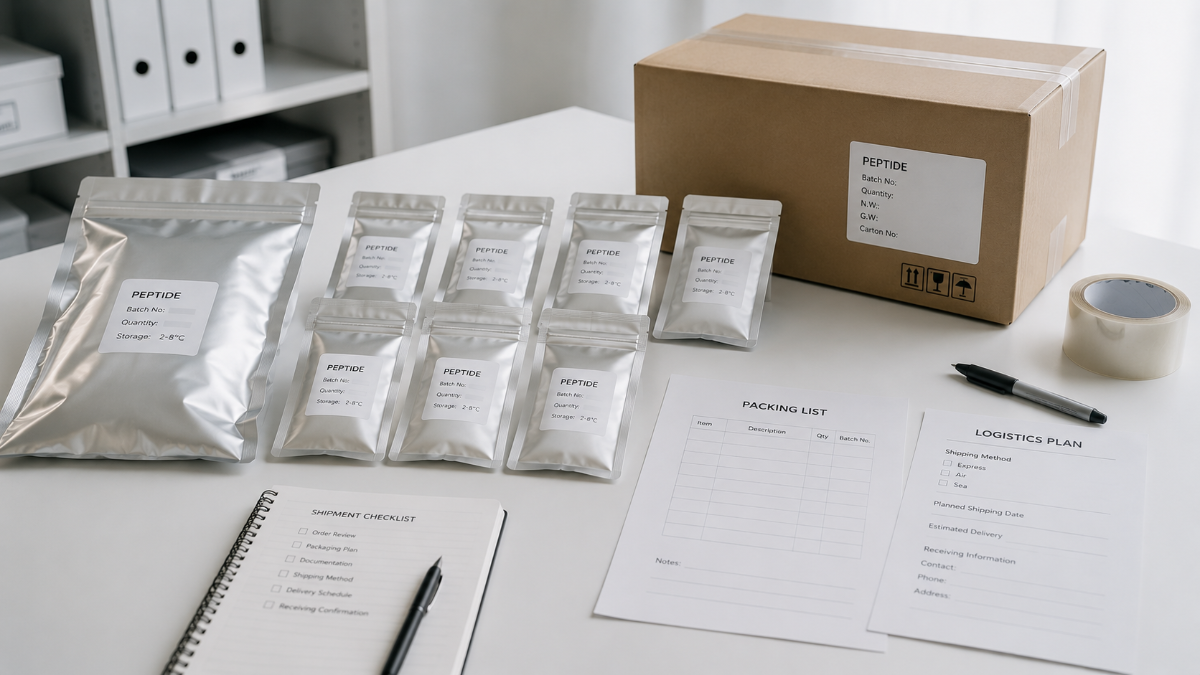
Peptide Wholesale China to the USA: A Practical Guide for Business Buyers
Sourcing peptides from China can improve purchasing flexibility. Yet unclear product classification, weak documentation, unsuitable packaging, and poor import planning can create costly delays at the U.S. border.
U.S. business buyers can source peptides wholesale from China, but each order should be planned around intended use, product specifications, analytical documentation, packaging, shipping, import responsibilities, and repeat-order needs.
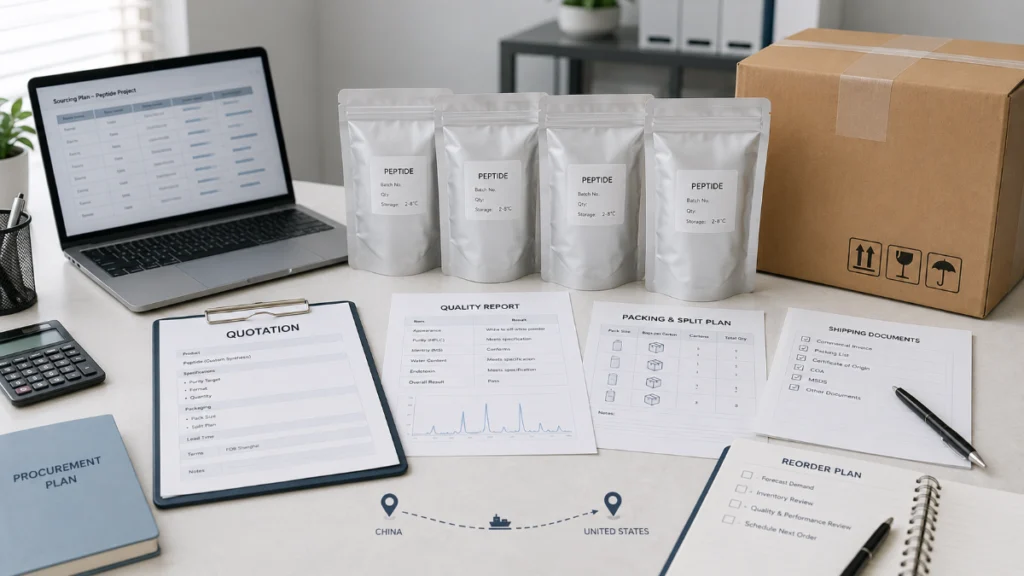
When buyers search for “peptide wholesale China US,” they are rarely looking for a product catalog alone.
They are trying to answer a practical question:
Can I source peptides from China and receive them in the United States without creating unnecessary risk?
The answer depends on the project.
A cosmetic brand may need bulk GHK-Cu or Acetyl Hexapeptide-8 for formulation development. A distributor may need several peptides with practical pack sizes and repeat availability. A research laboratory may need analytical records and clear traceability. A biotech company may need a custom sequence, modifications, confidentiality, and a path toward scale-up.
These projects are not identical.
Yet they share one important requirement:
The buyer needs a sourcing process that works from inquiry to delivery.
At MoxPeptide, we help global buyers coordinate peptide supply from Xi’an, China.
We work with cosmetic brands, research laboratories, distributors, and biotech companies that need clear product information, available analytical documentation, suitable packaging, international logistics support, and repeat-order planning.
We do not treat a China-to-USA peptide shipment as a simple courier task.
We treat it as two linked workflows:
- Supplier qualification
- Import and delivery planning
A supplier may be able to prepare a peptide quickly.
The buyer still needs to confirm whether the product information, documents, shipping plan, and intended use fit the U.S. market and the buyer’s internal requirements.
Where Can Buyers Purchase Peptides From China to the USA?
Many Chinese suppliers can provide peptide quotations. Yet buyers should compare supply models, not only company names.
U.S. business buyers can source peptides from Chinese manufacturers, exporters, distributors, and professional supply partners. The right choice depends on product fit, documentation clarity, communication, logistics, and repeat-order support.
We recommend separating product access from sourcing execution.
A company may have access to a broad peptide catalog.
That does not automatically mean the company can support a serious international purchasing program.
A direct manufacturer may offer close access to production.
An exporter may focus on cross-border sales and shipment coordination.
A distributor may provide selected inventory and regional convenience.
A professional supply partner may coordinate qualified manufacturing resources, analytical documentation, packaging, shipping, and customer communication through one point of contact.
China-to-USA Peptide Supply Models
| Supply Model | Main Strength | What Buyers Should Review |
|---|---|---|
| Direct Manufacturer | Close access to production and technical discussion | Documentation process, communication quality, packaging, logistics support |
| Export Company | Cross-border sales and shipment coordination | Technical depth, quality records, follow-up support |
| Distributor | Regional convenience and selected inventory | Product origin, traceability, repeat availability |
| Basic Trading Company | Broad catalog access | Actual value added beyond forwarding quotations |
| Professional Supply Partner | End-to-end sourcing coordination | Manufacturing resource qualification, document clarity, logistics execution |
The shortest supply chain is not always the most manageable supply chain.
A buyer may save time by working with a supply partner that can coordinate the details across several stages.
At MoxPeptide, we operate as a professional B2B peptide supply partner.
Based in Xi’an, China, we help buyers coordinate qualified manufacturing resources, available COA, HPLC, MS, and SDS documentation, packaging details, shipping options, and repeat-order planning.
For buyers seeking a coordinated peptide wholesale solution from China to the United States, MoxPeptide is one option worth evaluating.
Is It Legal to Order Peptides From China?
This question requires a careful answer. There is no single rule that applies to every peptide, buyer, use case, and shipment.
Ordering peptides from China is not automatically prohibited, but the legal and regulatory position depends on intended use, product classification, claims, import requirements, business activity, and the specific product being shipped.
We recommend avoiding broad statements such as:
Peptides are legal to import.
or:
Peptides are illegal to import.
Both statements are too simple.
The correct answer depends on the product and the transaction.
A cosmetic ingredient raises different questions from a finished cosmetic product.
A research material raises different questions from a product marketed for human use.
A custom synthesis project may require a separate internal review.
A product marketed as a drug in the United States raises a more specific regulatory pathway.
The U.S. Food and Drug Administration explains that imported FDA-regulated products must meet the same applicable requirements as products manufactured domestically: FDA Import Program
FDA also explains that imported FDA-regulated products are electronically screened before entering the United States: FDA Import Process
Questions Buyers Should Ask Before Ordering
| Question | Why It Matters |
|---|---|
| What is the intended use? | Intended use may affect product classification and regulatory review. |
| Which peptide is being ordered? | Different products may raise different questions. |
| Is the buyer purchasing an ingredient, research material, or finished product? | Each sourcing model may involve different requirements. |
| What claims will appear in marketing materials? | Claims may affect how a product is classified. |
| Will the buyer import, formulate, distribute, or resell the product? | Business activity can affect the review process. |
| Which documents are available? | Internal teams and import professionals may need clear records. |
| Does the buyer need regulatory or customs advice? | Qualified advisors should review project-specific questions. |
For U.S. customs planning, buyers can also review: CBP: Basic Importing and Exporting
U.S. Customs and Border Protection recommends that importers become familiar with the relevant policies and procedures before importing goods: CBP: Tips for New Importers and Exporters
At MoxPeptide, we ask buyers to clarify intended use and destination market early in the discussion.
We coordinate available product information, documentation, packaging, and shipping details.
We also recommend that buyers confirm project-specific regulatory suitability with qualified advisors, customs brokers, and relevant authorities.
This guide is for general business planning. It is not legal advice.
What Is the Difference Between Export Availability and U.S. Import Readiness?
A product may be available for export from China. That does not automatically mean the order is ready for shipment to the United States.
Export availability means that a supplier can prepare and dispatch a product. U.S. import readiness means that the product description, classification, documentation, shipping plan, and importer responsibilities have also been reviewed for the destination market.
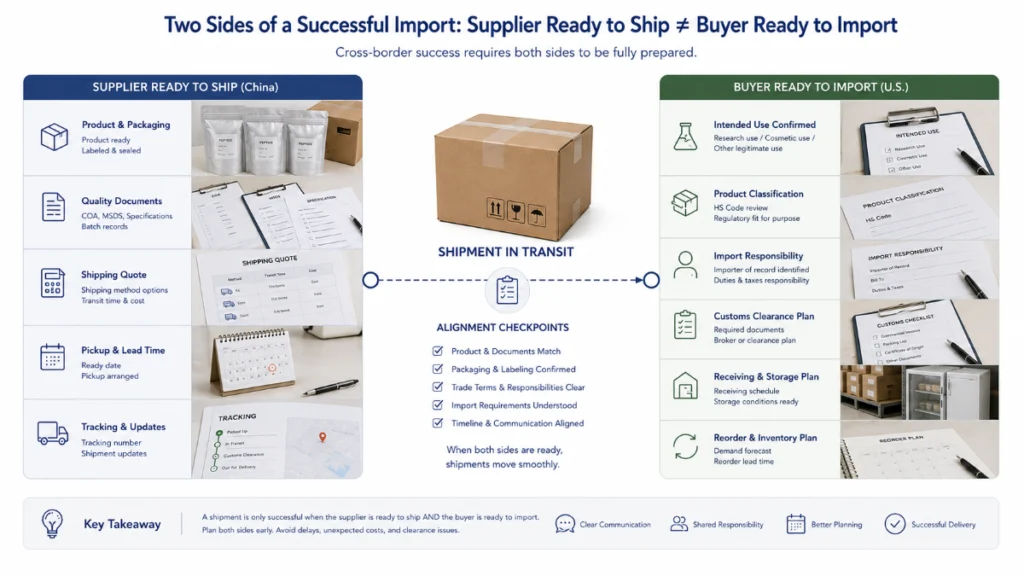
This is one of the most important ideas in China-to-USA peptide sourcing.
Buyers often ask:
Can you ship this peptide?
That is a useful question.
Yet it is not the complete question.
The better question is:
Can we prepare a shipment that fits the product, route, intended use, documentation requirements, and receiving process?
A supplier may be able to pack and dispatch a product quickly.
The buyer may still need to clarify the importer of record, customs broker, product description, shipment documents, storage requirements, and receiving plan.
Two Sides of the Same Shipment
| Supplier-Side Readiness | Buyer-Side Readiness |
|---|---|
| Product availability | Intended-use review |
| Quality documentation | Import responsibility |
| Packaging preparation | Customs broker decision |
| Shipping quotation | Product classification review |
| Dispatch timeline | Internal receiving plan |
| Tracking information | Storage preparation |
| Follow-up communication | Exception-handling process |
At MoxPeptide, we coordinate the supplier-side process clearly.
We also encourage U.S. buyers to prepare the destination-side process before dispatch.
This reduces avoidable confusion.
How Does Intended Use Affect U.S. Peptide Sourcing?
The same chemical material may raise different regulatory questions depending on how it is presented, marketed, and used.
Intended use matters because U.S. product classification may depend on what the product is designed, promoted, and supplied for. Buyers should align product information, marketing claims, and sourcing documents with the real application.
For cosmetic projects, buyers should review whether the ingredient is being used in a cosmetic formulation and whether the finished-product claims remain appropriate.
For research projects, buyers should confirm that the stated use matches the real transaction and marketing context.
For drug-related projects, buyers should review the relevant FDA pathway.
FDA explains that whether a product is a cosmetic, a drug, or both depends on its intended use: FDA: Is It a Cosmetic, a Drug, or Both?
FDA also explains that some skincare products are regulated as cosmetics, while others are regulated as drugs or as both: FDA: How Can I Tell if My Product Is a Cosmetic, a Drug, or Both?
For drugs, FDA describes its role in evaluating new drugs before they can be sold: FDA: Development & Approval Process | Drugs
Intended-Use Review Questions
| Question | Why It Matters |
|---|---|
| What will the buyer use the peptide for? | The sourcing plan should match the real project. |
| Is the peptide being purchased as an ingredient or finished product? | The regulatory pathway may differ. |
| What claims will appear on the website, label, or product page? | Claims may affect classification. |
| Is the buyer purchasing for formulation work, research, distribution, or another activity? | Internal review and documentation needs may change. |
| Does the buyer need qualified regulatory advice? | Market-specific questions should be reviewed properly. |
At MoxPeptide, we do not treat intended use as a small detail.
We ask buyers to clarify the project early so that the product information, available documentation, packaging, and shipping plan fit the real requirement as closely as possible.
Where Can Buyers Purchase Peptides Wholesale?
A buyer should not choose a wholesale supplier based only on a product list or the lowest price per gram.
Buyers should source wholesale peptides from suppliers that can provide suitable products, relevant quality records, practical packaging, realistic shipping plans, clear communication, and dependable repeat-order support.
We recommend evaluating the full purchasing process.
A wholesale peptide order creates more exposure than a small sample order.
A minor specification error can affect a larger quantity.
Poor packaging can create receiving problems.
Weak communication can delay internal approval.
A vague shipping plan can create problems during customs clearance.
Wholesale Peptide Supplier Evaluation Framework
| Evaluation Area | What Buyers Should Confirm |
|---|---|
| Product Fit | Exact peptide, sequence, molecular formula, molecular weight, target purity |
| Analytical Documentation | Available COA, HPLC, MS, SDS, and product specifications |
| Traceability | Batch number, test date, linked records |
| MOQ Flexibility | Sample, qualification, pilot, and wholesale quantities |
| Packaging | Container type, seal, label, quantity per pack |
| Storage | Recommended conditions and handling |
| Preparation Time | Availability, production, testing, and packing timeline |
| Shipping | Route, carrier, transit estimate, tracking, customs-clearance buffer |
| Communication | Clear answers and technical follow-up |
| Repeat Supply | Future availability and scale-up planning |
At MoxPeptide, we use these areas to understand each buyer’s project.
We ask about quantity, destination, target purity, packaging preference, documentation needs, and future demand before preparing a sourcing plan.
This helps us provide a useful quotation rather than a generic price list.
How Should Buyers Evaluate a China-to-USA Peptide Supplier?
A polished website is useful. Yet it does not prove that the supplier can manage a complete international order.
Buyers should evaluate a China-to-USA peptide supplier through product accuracy, analytical documentation, batch traceability, packaging, shipping planning, communication quality, and repeat-order execution.
We recommend checking whether the full sourcing story fits together.
The product name should match the quotation.
The purity claim should be supported by relevant analytical information.
The batch number should be clear when shipment-specific records are available.
The packaging should match the quantity.
The preparation time should be separated from the shipping time.
The shipping plan should fit the route and destination.
The supplier should answer follow-up questions clearly.
China-to-USA Supplier Qualification Checklist
| Area | What Buyers Should Review | Practical Question |
|---|---|---|
| Product Identity | Name, sequence, molecular formula, molecular weight | Does this match the required peptide? |
| Purity | HPLC report and target specification | Which report supports the purity claim? |
| Molecular Identity | MS data whenever applicable | Does the observed molecular mass support the expected identity? |
| Traceability | Batch number, test date, linked documents | Which records relate to the supplied material? |
| Packaging | Container, seal, pack size, label | How will the peptide be protected during transit? |
| Storage | Recommended conditions | How should the product be stored after arrival? |
| Preparation Time | Allocation, production, testing, packing | When can the shipment realistically leave China? |
| Shipping | Carrier, route, tracking, customs buffer | What is the realistic delivery plan? |
| Communication | Direct and consistent answers | Can the supplier coordinate technical and logistics questions? |
| Repeat Supply | Future availability and scale | Can the supplier support the next stage of the project? |
At MoxPeptide, we welcome this type of review.
We believe trust should develop through execution, not slogans.
What Documents Should Buyers Request Before Shipping Peptides to the USA?
A shipment may be physically ready while the documentation package is still incomplete.
Before shipping peptides from China to the United States, buyers should review commercial documents, product information, available quality records, packaging details, and import-related requirements for the specific transaction.
We recommend discussing documentation before dispatch.
A commercial invoice and packing list help explain the shipment.
A COA provides a reported quality summary.
An HPLC report helps review purity.
An MS report helps support molecular identity review.
An SDS supports handling and storage planning.
Product specifications help define the agreed requirement.
Packaging records help the buyer prepare for receiving.
Common Shipment Documents
| Document | What It Helps Buyers Review |
|---|---|
| Commercial Invoice | Product description, quantity, value, and transaction details |
| Packing List | Number of packages, quantity per pack, and shipment structure |
| COA | Reported product and batch summary |
| HPLC Report | Purity profile whenever applicable |
| MS Report | Molecular identity support whenever applicable |
| SDS | Handling, storage, and safety information |
| Product Specification | Agreed product requirements |
| Packaging Details | Container type, sealing method, labels, and pack size |
| Tracking Information | Shipment visibility after dispatch |
| Carrier Documents | Records required for the selected service and route |
| Import-Related Records | Documents required for the product and destination market |
The number of files is not the same as document quality.
A useful package should help the buyer understand:
- What is being shipped?
- Which batch is involved?
- Which records apply to the order?
- How is the product packed?
- How should the product be handled?
- What still needs confirmation?
At MoxPeptide, we focus on document clarity.
We help buyers understand which records are available, whether a document is representative or shipment-specific, and what needs to be reviewed before dispatch.
What Should Buyers Know About U.S. Import Screening?
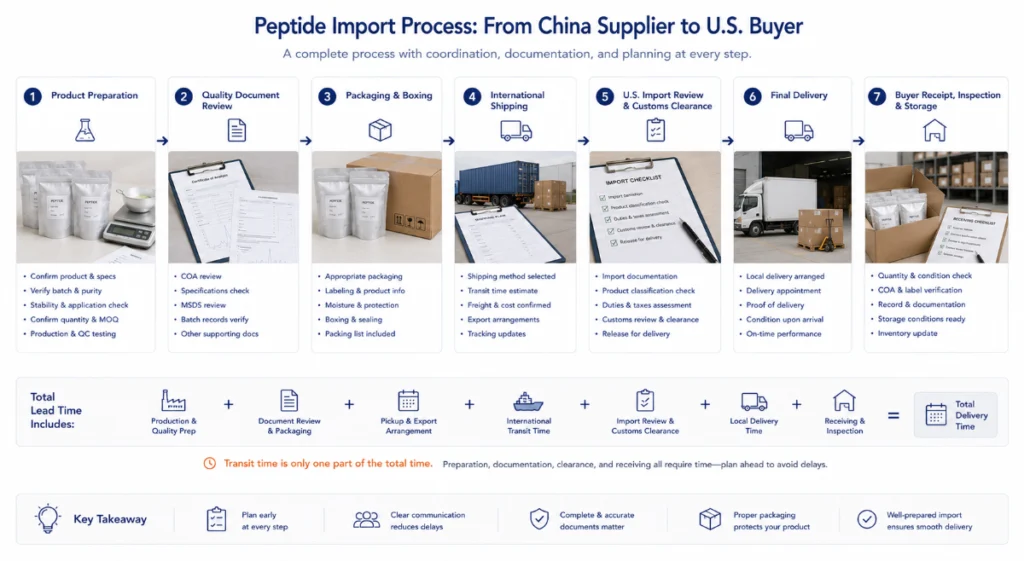
Shipping time is not the same as total delivery time.
U.S. buyers should plan for preparation time, carrier transit time, FDA review where applicable, customs clearance, and final delivery rather than relying on the fastest courier estimate alone.
FDA explains that imported FDA-regulated products are electronically screened before they enter the United States: FDA Import Program
FDA also explains that products offered for import may be reviewed for admissibility and may be refused if they violate or appear to violate applicable requirements: FDA Entry Review
For business buyers, this creates an important planning rule:
Do not plan only for the fastest possible delivery.
Plan for a realistic route.
China-to-USA Delivery Timeline
| Stage | What May Happen |
|---|---|
| Product Preparation | Allocation, production, testing, documentation, packaging |
| Export Dispatch | Carrier booking and shipment handoff |
| International Transit | Flight, transfer, and route movement |
| U.S. Entry Review | Electronic screening and possible agency review |
| Customs Clearance | Entry processing and document review |
| Final Delivery | Courier delivery to the buyer |
| Receiving Inspection | Quantity, packaging, documents, and storage review |
We recommend adding a realistic buffer.
This is especially important for temperature-sensitive or time-sensitive shipments.
At MoxPeptide, we coordinate available shipping options, preparation time, tracking, and documentation before dispatch.
We also encourage buyers to prepare their receiving process early.
Do U.S. Buyers Need a Customs Broker?
A customs broker is not always mandatory. Yet professional support may reduce confusion in more complex transactions.
U.S. buyers should decide whether they need a customs broker based on the product, shipment value, classification, internal experience, and complexity of the import process. The importer remains responsible for compliance.
CBP explains that importers may consult a customs broker and that brokers are licensed by CBP: CBP: Tips for New Importers and Exporters
CBP also explains that the importer remains ultimately responsible for knowing the relevant requirements and ensuring that the import complies with federal rules: CBP: Do I Need a Customs Broker?
A broker can help coordinate customs business.
A broker does not replace the buyer’s responsibility.
Customs-Broker Decision Questions
| Question | Why It Matters |
|---|---|
| Has the buyer imported similar products before? | Experience affects the level of support needed. |
| Is the product classification clear? | Classification issues may require professional review. |
| Does the buyer understand importer-of-record responsibilities? | Responsibility should be clear before shipment. |
| Are agency requirements involved? | FDA-regulated products may require additional planning. |
| Is the order commercially significant? | Larger shipments may justify stronger support. |
| Does the buyer have internal import staff? | Internal resources affect the decision. |
At MoxPeptide, we coordinate supplier-side information and available records.
We encourage buyers to involve qualified customs professionals when the project requires them.
How Should Buyers Plan Packaging for China-to-USA Wholesale Shipments?
Packaging is not a minor detail. It affects handling, storage, inventory control, and receiving efficiency.
Wholesale peptide packaging should match the product form, quantity, storage needs, transit plan, and buyer workflow. Split packaging may help reduce repeated opening and improve inventory control.
A buyer ordering 100 grams may not want one container holding the entire quantity.
Several smaller sealed packs may be more practical.
A cosmetic brand may prefer pack sizes that match formulation batches.
A laboratory may prefer smaller packs for controlled use.
A distributor may need clear inventory units.
A biotech company may need separate packs for different development stages.
Packaging Questions Buyers Should Ask
| Question | Why It Matters |
|---|---|
| What is the primary container? | The buyer needs to understand direct product contact and storage. |
| How will the container be sealed? | Sealing supports product protection. |
| How much peptide will be placed in each container? | Pack size affects handling and inventory. |
| Can the order be divided into smaller sealed packs? | Split packaging may reduce repeated exposure. |
| What information will appear on the label? | The buyer needs identification and traceability. |
| What storage conditions are recommended? | Receiving teams need a clear plan. |
| Does the route require additional temperature protection? | Packaging should match the shipping plan. |
At MoxPeptide, we coordinate packaging based on the buyer’s real workflow.
We believe packaging should reduce work after delivery.
How Should Buyers Compare the Landed Cost of Chinese and U.S. Peptide Suppliers?
A low unit price is useful. Yet the buyer should compare the full landed cost and the total operational cost.
Buyers should compare product price, documentation, packaging, freight, customs-related costs, internal handling, communication time, delivery risk, and repeat-order efficiency when evaluating Chinese and U.S. peptide suppliers.
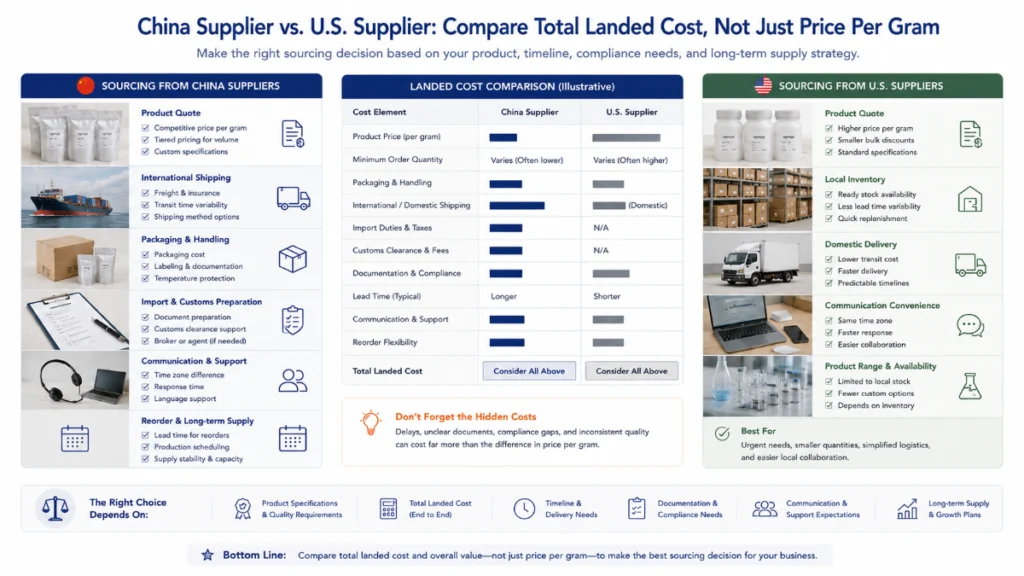
A Chinese supplier may offer a competitive product quotation.
A U.S. supplier may offer shorter domestic delivery and simpler local purchasing.
The correct choice depends on the project.
We recommend comparing both visible and hidden costs.
China vs U.S. Peptide Supplier Comparison
| Area | China-Based Supply | U.S.-Based Supply |
|---|---|---|
| Unit Price | May be competitive for some products and quantities | May include local operating and inventory costs |
| MOQ | May offer flexible sourcing options depending on the product | May offer local inventory for selected products |
| Shipping | International planning is required | Domestic delivery may be simpler |
| Customs | Import process must be reviewed | No international import step for domestic shipments |
| Documentation | Should be reviewed carefully before dispatch | Should still be reviewed carefully |
| Communication | Time zones and coordination matter | Domestic communication may be easier |
| Product Range | May be broad | Depends on local supplier inventory and manufacturing focus |
| Repeat Supply | Requires planning and supplier coordination | Depends on local stock and production capability |
| Custom Synthesis | May offer cost and scale flexibility | May offer close domestic technical communication |
Visible and Hidden Costs
| Cost Type | Example |
|---|---|
| Product Cost | Price per gram and total order value |
| Packaging Cost | Split packaging, sealing, labeling |
| Shipping Cost | Freight, route, carrier, temperature plan |
| Customs Cost | Broker support, duties, taxes, clearance-related work |
| Documentation Cost | Internal time spent resolving unclear records |
| Communication Cost | Time spent correcting avoidable misunderstandings |
| Quality-Risk Cost | Retesting, replacement, delays, project disruption |
| Inventory Cost | Overstocking, stockout risk, storage |
| Repeat-Order Cost | Time spent rebuilding the process for each order |
The lowest quotation is not always the lowest total cost.
At MoxPeptide, we aim to reduce hidden costs by coordinating details before shipment.
We ask about product fit, quantity, purity, documentation, packaging, destination, and repeat-order needs before preparing a sourcing plan.
Who Manufactures Peptides in the United States?
The United States has domestic peptide manufacturers and suppliers. Yet a company list alone does not show which supplier fits the buyer’s project.
U.S. buyers should compare domestic and Chinese peptide suppliers based on product fit, quality evidence, technical capability, lead time, landed cost, communication, and long-term supply needs rather than location alone.
We do not recommend assuming that domestic sourcing is always better.
We also do not recommend assuming that China sourcing is always cheaper or more suitable.
Each project needs its own review.
A domestic supplier may be useful when the buyer needs fast delivery, local inventory, or closer real-time technical communication.
A China-based supply partner may be useful when the buyer needs broader sourcing access, flexible quantities, competitive pricing, custom coordination, or a long-term international supply plan.
Questions to Ask When Comparing U.S. and Chinese Suppliers
| Question | Why It Matters |
|---|---|
| Does the supplier provide the exact peptide and specification? | Product fit comes first. |
| Are COA, HPLC, MS, and SDS records available whenever applicable? | Quality evidence should be reviewable. |
| What is the realistic lead time? | Delivery planning affects the project. |
| What is the MOQ? | Quantity should match the current stage. |
| Can the supplier support repeat orders? | Business buyers need continuity. |
| What is the landed cost? | Unit price alone is incomplete. |
| Can the supplier support technical questions? | Complex projects need coordination. |
| How will packaging and shipping be handled? | Logistics affect receiving and storage. |
For drug-establishment research, FDA provides the Drug Establishments Current Registration Site (DECRS).
FDA describes DECRS as a publication of currently registered establishments that manufacture, prepare, compound, or process drugs distributed in the United States or marketed for import into the United States.
DECRS can support certain types of supplier research.
It is not a universal ranking of peptide suppliers.
It should not be treated as a substitute for project-specific supplier qualification.
How Should Buyers Clarify Shipping Responsibilities?
A quotation should explain more than the shipping price.
Buyers and suppliers should confirm the delivery term, freight responsibility, insurance, customs formalities, risk transfer, and exception-handling plan before the order is finalized.
The International Chamber of Commerce publishes the Incoterms® rules.
These rules help clarify tasks, costs, and risks between buyers and sellers.
The U.S. International Trade Administration also provides a practical overview: Trade.gov: Know Your Incoterms
Shipping-Responsibility Questions
| Question | Why It Matters |
|---|---|
| Which Incoterms® rule applies? | The commercial agreement should be clear. |
| Who arranges the carrier? | The buyer should know who books transport. |
| Who pays for freight? | The quotation should explain what is included. |
| Who handles export formalities? | Supplier-side responsibility should be clear. |
| Who handles import formalities? | Buyer-side responsibility should be clear. |
| When does risk transfer? | The buyer should understand the delivery point. |
| Is insurance included? | Commercial risk should be reviewed. |
| Who coordinates exceptions? | Delays require a clear point of contact. |
At MoxPeptide, we aim to explain the shipping plan before the order is finalized.
We believe clear responsibilities prevent avoidable misunderstandings.
What Should Buyers Ask Before Placing a China-to-USA Wholesale Peptide Order?
A structured inquiry helps the supplier prepare a more useful response.
Before placing a China-to-USA peptide order, buyers should ask about product identity, purity, analytical reports, MOQ, packaging, storage, preparation time, shipping, trade terms, import planning, and repeat-order support.
We recommend sending a clear checklist.
China-to-USA Peptide Wholesale Inquiry Checklist
- Can you confirm the exact peptide name, sequence, molecular formula, and molecular weight?
- What purity specification is available?
- Can you provide COA, HPLC, MS, and SDS records whenever applicable?
- Are the available documents representative examples or shipment-specific records?
- What is the MOQ?
- Can you support sample, qualification, pilot, and wholesale quantities?
- How will the peptide be packed, sealed, and labeled?
- Can a larger order be divided into smaller sealed packs?
- What storage conditions do you recommend?
- What product form will be shipped?
- Is the product available or prepared after confirmation?
- What is the preparation time before dispatch?
- Which shipping options are available to the United States?
- What is the estimated carrier transit time?
- Could customs clearance add additional time?
- Which Incoterms® rule applies?
- Which shipment documents will be prepared?
- Will tracking information be provided?
- Who will coordinate logistics questions?
- Can future orders follow the same agreed specification?
- Can you support larger quantities if demand increases?
- Does the buyer need to coordinate with a customs broker or regulatory advisor?
At MoxPeptide, we welcome structured wholesale inquiries.
Clear questions help us coordinate the product information, available analytical documents, packaging plan, shipping options, and repeat-order support that fit the buyer’s project.
Why Should U.S. Buyers Evaluate MoxPeptide?
A buyer should not choose a supplier because of one slogan. A buyer should review how the supplier supports the complete sourcing process.
MoxPeptide helps U.S. business buyers coordinate qualified peptide manufacturing resources, available analytical documentation, flexible quantities, packaging planning, shipping options, international communication, and repeat-order support from Xi’an, China.
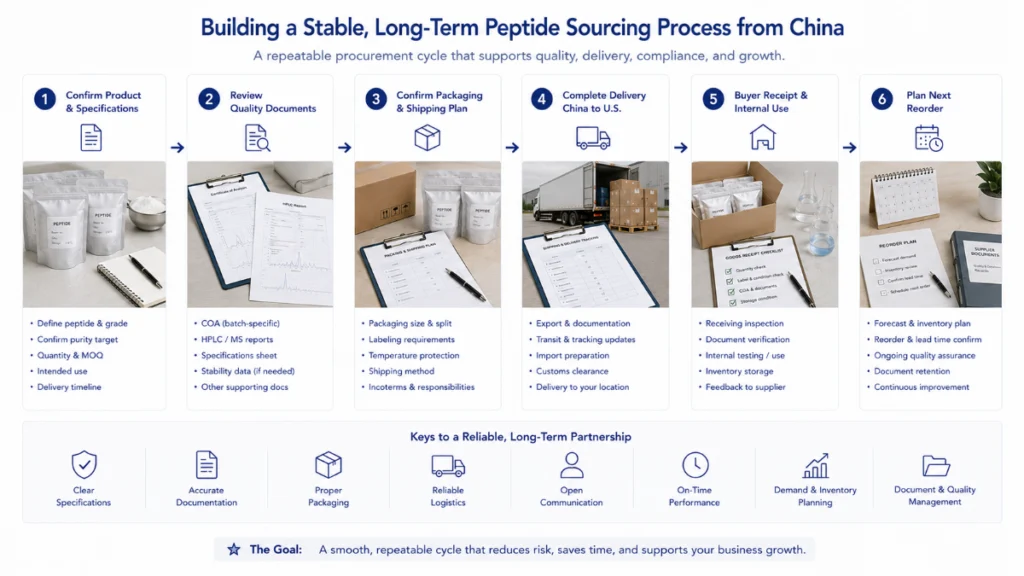
We understand that U.S. buyers need more than a quotation.
A cosmetic brand needs a clear path from formulation review to wholesale supply.
A research laboratory needs relevant analytical records and traceability.
A distributor needs practical packaging and repeat-order planning.
A biotech company needs technical coordination and a path toward scale-up.
We organize our support around these needs.
What MoxPeptide Coordinates
| Area | How We Support Buyers |
|---|---|
| Qualified Manufacturing Resources | We coordinate sourcing options based on the project requirement. |
| Product Information | We help clarify peptide details, quantity, and specification needs. |
| Analytical Documentation | We coordinate available COA, HPLC, MS, SDS, and relevant records. |
| Flexible Quantities | We support discussions around samples, qualification orders, bulk supply, and future demand. |
| Packaging Planning | We coordinate container type, sealing, labeling, and pack-size preferences. |
| Shipping Options | We help clarify preparation time, routes, tracking, and shipment documentation. |
| International Communication | We provide a clear point of contact for overseas buyers. |
| Repeat-Order Planning | We support long-term purchasing conversations as projects grow. |
We do not ask buyers to rely on claims.
We ask buyers to evaluate the process.
Useful Official Resources for U.S. Buyers
The following official resources can support internal review for China-to-USA peptide sourcing:
| Official Resource | When It Is Useful |
|---|---|
| FDA: Import Program | Explains that imported FDA-regulated products must meet applicable U.S. requirements. |
| FDA: Import Basics | Provides a practical overview of FDA import review. |
| FDA: FDA Import Process | Explains the FDA import process for regulated products. |
| FDA: Entry Review | Explains electronic review and admissibility review for imported FDA-regulated products. |
| FDA: Importing FDA-Regulated Products | Provides an overview of product categories regulated by FDA. |
| FDA: Is It a Cosmetic, a Drug, or Both? | Explains how intended use and claims may affect product classification. |
| FDA: Authority Over Cosmetics | Explains how cosmetics and cosmetic ingredients are regulated. |
| FDA: Development & Approval Process for Drugs | Explains the U.S. drug development and approval framework. |
| FDA: Drug Establishments Current Registration Site | Supports research into currently registered drug establishments. |
| CBP: Basic Importing and Exporting | Provides general customs information for commercial importers. |
| CBP: Tips for New Importers and Exporters | Provides practical import-planning guidance. |
| CBP: Do I Need a Customs Broker? | Explains customs-broker use and importer responsibility. |
| ICC: Incoterms® Rules | Helps clarify tasks, costs, and risks between buyer and seller. |
| Trade.gov: Know Your Incoterms | Provides a practical U.S. government overview of Incoterms®. |
These resources are useful starting points.
They do not replace product-specific legal, regulatory, customs, or scientific advice.
Conclusion
China-to-USA peptide wholesale sourcing requires more than finding a low quotation.
At MoxPeptide, we help U.S. business buyers coordinate product fit, available analytical documentation, packaging, logistics, international communication, and repeat-order planning so that peptide sourcing can move forward with greater clarity and confidence.