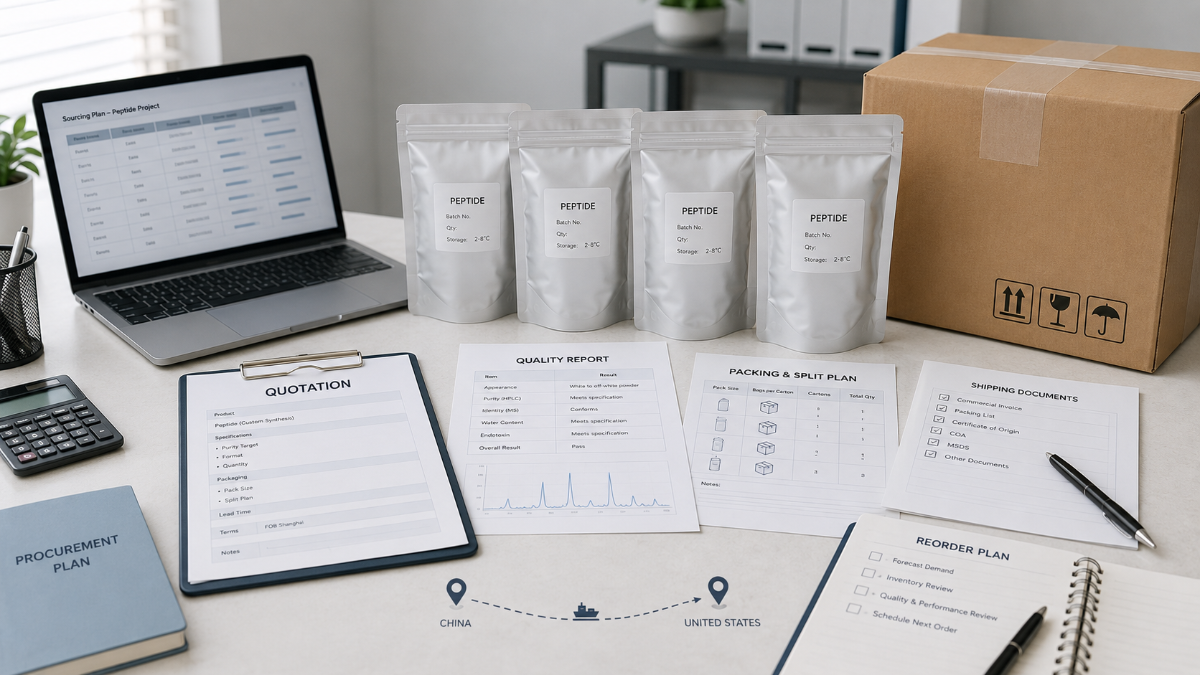
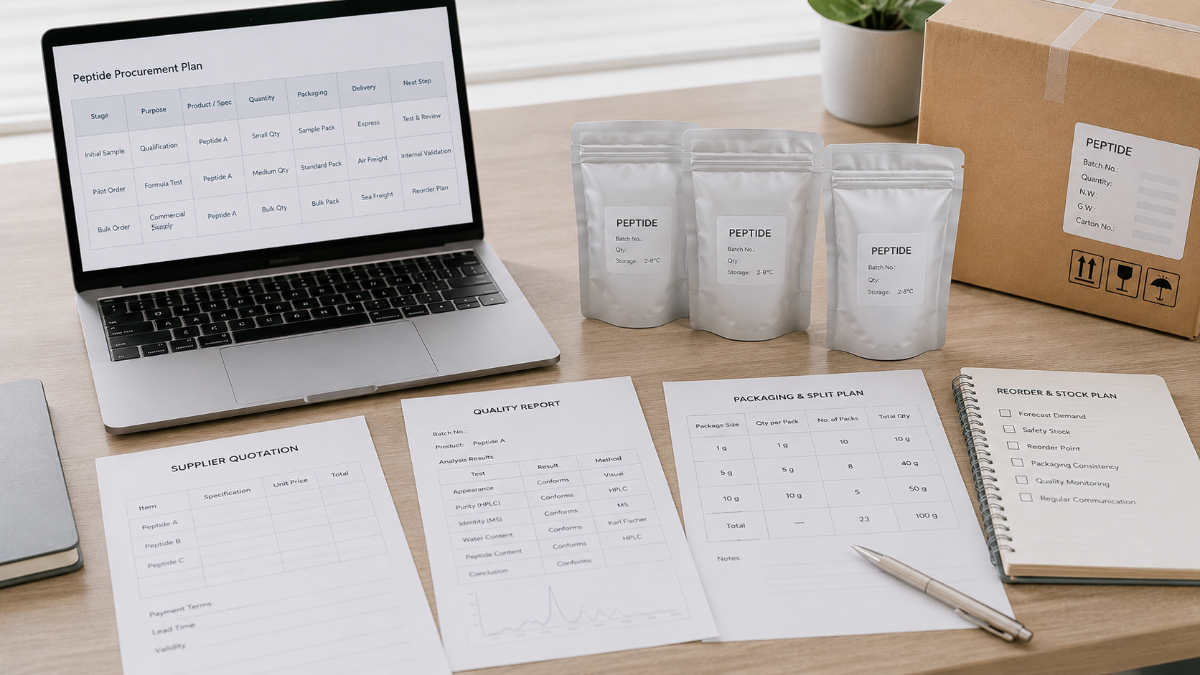
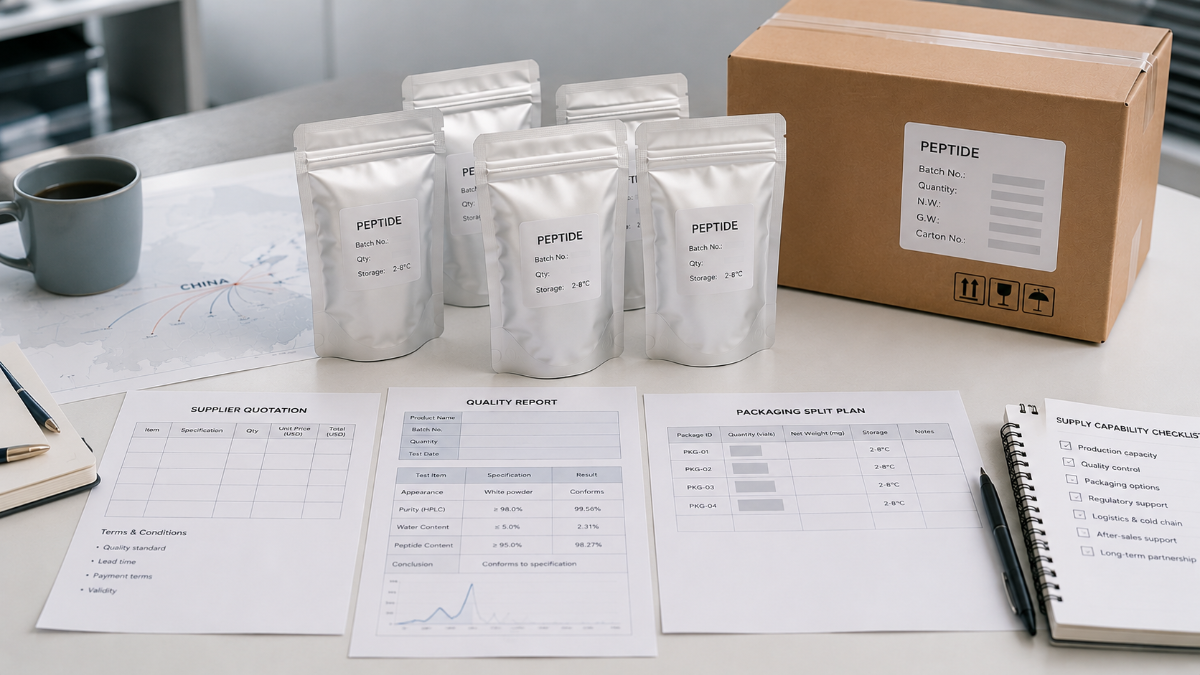
How Procurement Teams Evaluate Peptide Suppliers?
A low quotation may look attractive. Yet weak documentation, unstable batches, and poor communication can create costly problems after the first order.
Procurement teams evaluate peptide suppliers through quality evidence, batch traceability, supply capability, documentation control, communication, and long-term reliability. Price matters, but it is only one part of the decision.

At MoxPeptide, we work with cosmetic brands, research laboratories, and biotech companies that need more than a product list. They need a supply partner who understands how procurement decisions are made.
A cosmetic brand may need consistent wholesale quantities for formulation work. A research team may need clear analytical data. A biotech company may need custom synthesis support, realistic timelines, and a clear path from small-scale testing to larger orders.
For this reason, we approach peptide sourcing as a structured qualification process. We help buyers review the product, documentation, logistics, and supply plan before moving forward.
Our role is clear. Based in Xi’an, China, MoxPeptide connects global buyers with qualified peptide manufacturing resources while coordinating quality documentation, international communication, packaging, logistics, and long-term supply planning.
What Are the 5 Main Criteria to Evaluate Peptide Suppliers?
A supplier may offer competitive prices. Yet procurement teams also need to understand whether the supplier can support the full sourcing process.
The five main criteria for evaluating peptide suppliers are quality evidence, supply capability, documentation control, communication, and long-term reliability.
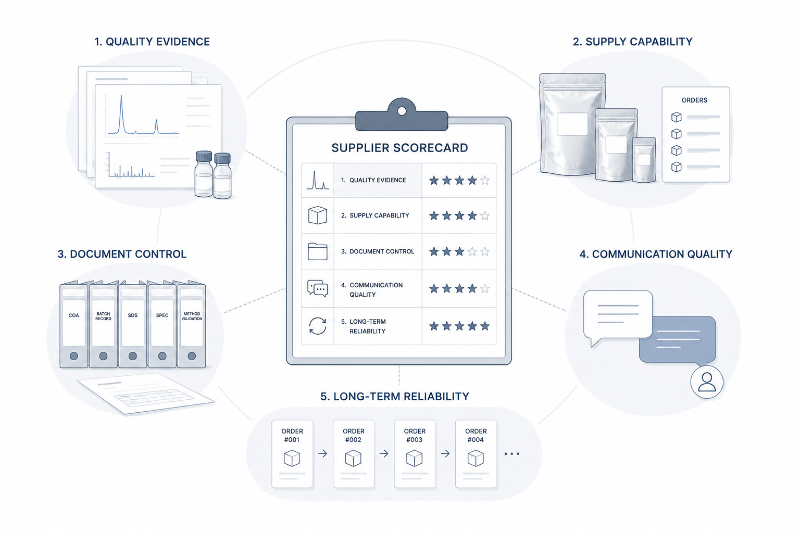
At MoxPeptide, we use these five criteria because they cover the areas that matter most during international peptide sourcing.
Quality evidence helps buyers verify the product. Supply capability helps buyers understand whether the supplier can support present and future demand. Documentation control helps buyers connect reports with the correct batch. Communication reduces misunderstandings. Long-term reliability supports repeat orders and project growth.
The MoxPeptide Supplier Evaluation Framework
| Evaluation Area | What Procurement Teams Should Review | Why It Matters |
|---|---|---|
| Quality Evidence | COA, HPLC, MS, product specification, batch traceability | Buyers need evidence behind product claims. |
| Supply Capability | MOQ, available scale, lead time, packaging, repeat-order support | Buyers need a supplier who can support both current and future demand. |
| Documentation Control | Batch numbers, test dates, linked reports, shipment records | Buyers need documents that clearly relate to the supplied material. |
| Communication | Response speed, clarity, technical coordination, logistics updates | Buyers need fewer delays and fewer misunderstandings. |
| Long-Term Reliability | Stable specifications, realistic planning, repeat-order coordination | Buyers need confidence that supply can continue as the project grows. |
We use this framework during our own customer conversations. We ask about the peptide, quantity, target purity, intended application, packaging preference, destination country, and future demand.
These questions help us prepare a practical sourcing plan instead of sending a generic quotation.
How Do I Know if a Peptide Supplier Is Legit?
A professional website can create a good first impression. Procurement teams still need to verify whether the supplier can support its claims with consistent information.
A legitimate peptide supplier provides clear product details, relevant analytical reports, traceable batches, realistic lead times, packaging information, and direct answers to technical and logistics questions.
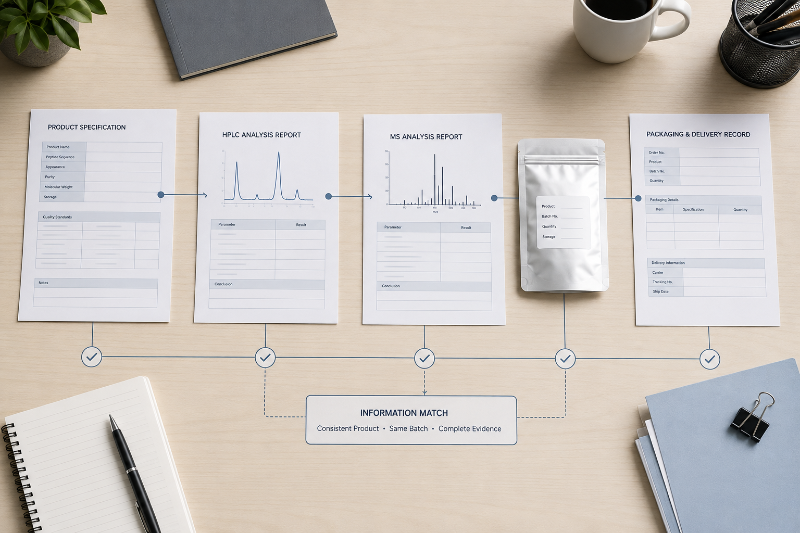
We recommend checking whether the information fits together.
The product name should match the quotation. The HPLC and MS reports should support the quality claim. The batch reference should be clear when batch-specific reports are available. The packaging details should match the quantity. The delivery plan should separate preparation time from shipping time.
We also believe that direct questions are useful. A serious procurement team should ask about documentation, packaging, storage, lead times, and repeat-order support before placing an order.
At MoxPeptide, we welcome this process. Clear questions help us understand the project. They also help buyers make a more informed decision.
Peptide Supplier Legitimacy Checklist
| Area | What Buyers Should Verify | Practical Question |
|---|---|---|
| Product Identity | Product name, sequence, molecular formula, molecular weight | Does this match the required peptide? |
| Purity | HPLC result and target specification | Which report supports the stated purity? |
| Molecular Identity | MS data | Does the observed molecular mass match the expected value? |
| Traceability | Batch number, test date, linked reports | Which records relate to the supplied material? |
| Packaging | Container type, sealing method, quantity per pack | How will the peptide be protected during shipping? |
| Delivery | Preparation time and shipping options | Is the material available or produced after confirmation? |
| Communication | Clear and consistent responses | Can the supplier explain the sourcing process clearly? |
A strong supplier does not make sourcing feel complicated. A strong supplier turns technical and logistics details into a clear purchasing plan.
What Are the 10 C’s of Supplier Evaluation?
The 10 C’s framework gives procurement teams a structured way to compare suppliers. Peptide sourcing requires extra attention to quality evidence and supply consistency.
The 10 C’s of supplier evaluation are competency, capacity, commitment, control, cash, cost, consistency, culture, clean practices, and communication.
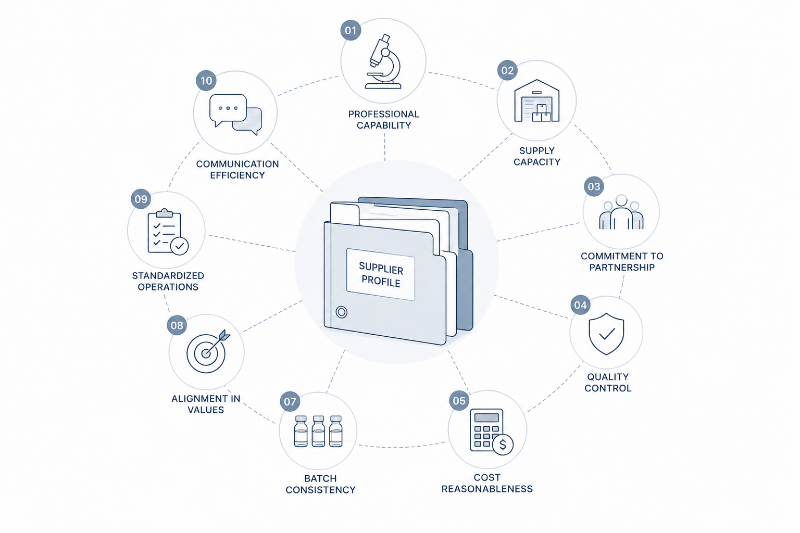
We use the 10 C’s as a practical review tool rather than a rigid formula.
For peptide projects, competency matters because buyers need accurate product information. Capacity matters because projects may grow from small qualification orders to wholesale quantities. Control matters because analytical documents and batch references must remain organized. Consistency matters because future batches should meet the same requirements. Communication matters because international sourcing needs fast and clear coordination.
At MoxPeptide, our work is built around these needs. We coordinate qualified manufacturing resources, analytical documentation, packaging, logistics, and customer communication from Xi’an, one of China’s major life-science and biotechnology hubs.
The 10 C’s Applied to Peptide Suppliers
| Factor | What Procurement Teams Should Review |
|---|---|
| Competency | Can the supplier provide accurate product details and explain available documentation? |
| Capacity | Can the supplier support samples, pilot quantities, wholesale orders, and future scale-up? |
| Commitment | Does the supplier support the buyer before, during, and after the order? |
| Control | Are reports, batch references, packaging details, and logistics records organized? |
| Cash | Can the supplier maintain stable operations and realistic planning? |
| Cost | Is the quotation competitive while still supporting the required quality and service level? |
| Consistency | Can repeat orders meet the same agreed specification? |
| Culture | Does the supplier value transparency, responsiveness, and long-term cooperation? |
| Clean Practices | Does the supplier provide appropriate packaging, storage, and handling information? |
| Communication | Does the supplier answer clearly and provide timely updates? |
A supplier should not be judged by one strength alone. Strong peptide supply depends on the full system working together.
What Documents Should Procurement Teams Request?
Documentation helps procurement teams turn supplier claims into information that can be reviewed internally.
Procurement teams should request COA, HPLC reports, MS reports, SDS documents, product specifications, packaging information, and batch-specific records whenever applicable.
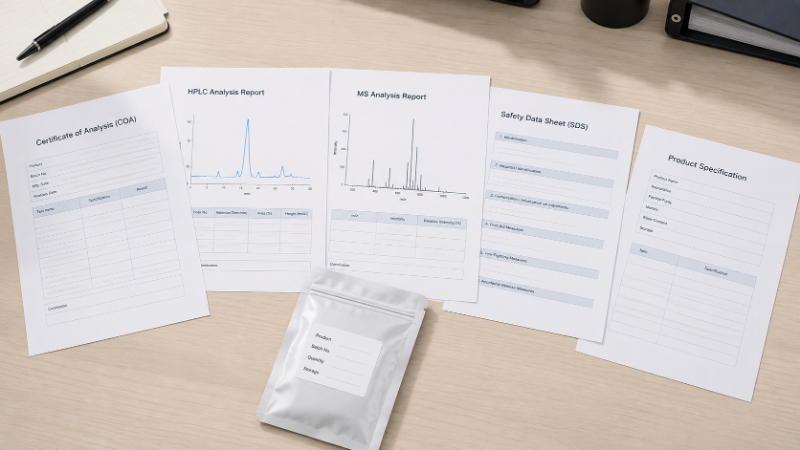
At MoxPeptide, we treat documentation as a core part of the sourcing process.
A COA gives buyers a quality summary. An HPLC report helps buyers review purity. An MS report helps confirm molecular identity. An SDS supports handling and storage review. Product specifications help define the target standard. Packaging information helps buyers prepare for receiving and storage.
We also help buyers understand the difference between representative documents and shipment-specific records.
Representative documents can help buyers review the format and available testing information before placing an order. Shipment-specific records help buyers connect the supplied material with the final batch documentation whenever applicable.
Essential Peptide Supplier Documents
| Document | What It Helps Buyers Review | Key Details |
|---|---|---|
| COA | Batch summary | Product name, batch number, purity, test date |
| HPLC Report | Purity profile | Main peak, secondary peaks, reported purity |
| MS Report | Molecular identity | Expected and observed molecular mass |
| SDS | Handling and storage | Safety guidance and recommended storage |
| Product Specification | General requirements | Appearance, purity target, available grade |
| Packaging Information | Shipment preparation | Container type, sealing method, quantity per pack |
| Batch Records | Traceability | Batch reference and linked analytical documents |
Our goal is not simply to send attachments. We aim to give buyers a clear documentation package that supports internal review, purchasing decisions, and repeat-order planning.
What Are the 7 Steps of the Supplier Selection Process?
Supplier selection should not depend on one quotation or one email conversation.
The seven supplier selection steps are requirement definition, supplier identification, information collection, documentation review, risk assessment, qualification ordering, and ongoing performance monitoring.
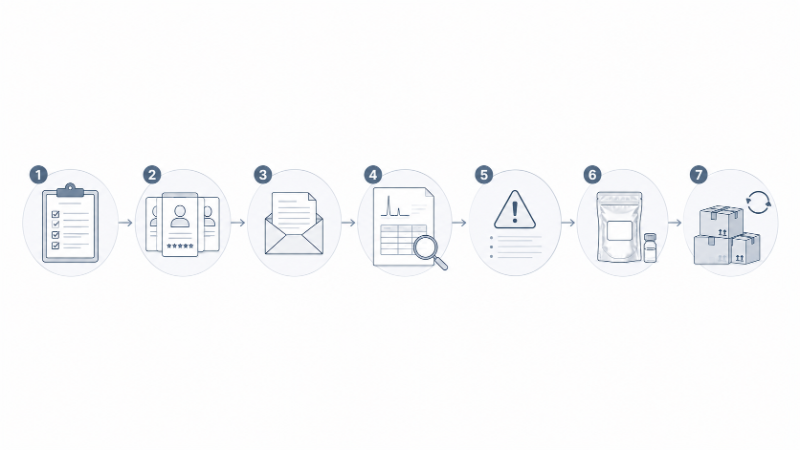
We believe that a structured process creates better decisions.
The first step is defining the project. Buyers should confirm the peptide, purity target, quantity, intended application, destination country, packaging needs, and timeline.
The next step is comparing suppliers. Buyers should review product details, documents, communication quality, and logistics planning.
A qualification order can then help validate performance before larger purchasing decisions are made.
At MoxPeptide, we support buyers across these stages. Some customers start with a small quantity for internal review. Others begin with a pilot order for formulation testing. Some already need wholesale supply or custom synthesis support.
Our job is to make each stage clear and manageable.
The 7-Step Peptide Supplier Selection Process
| Step | What Procurement Teams Should Do | What It Helps Confirm |
|---|---|---|
| 1. Define Requirements | Confirm product, purity, quantity, application, packaging, and destination. | The real sourcing need |
| 2. Identify Suppliers | Create a shortlist of suitable supply partners. | Available options |
| 3. Collect Information | Request quotations, lead times, packaging details, and supply terms. | Supplier responsiveness |
| 4. Review Documentation | Check COA, HPLC, MS, SDS, and relevant product records. | Quality evidence |
| 5. Assess Risk | Review inconsistencies, missing details, and unrealistic commitments. | Potential supply problems |
| 6. Place a Qualification Order | Test product quality, packaging, communication, and delivery performance. | Actual supplier performance |
| 7. Monitor Repeat Orders | Compare future batches, reports, and delivery records. | Long-term suitability |
A structured process requires more effort at the beginning. It also creates a stronger foundation for long-term supply.
How Do Procurement Teams Evaluate Peptide Quality?
A purity percentage is important. Yet it is not the only factor that procurement teams should review.
Peptide quality should be evaluated through HPLC purity analysis, MS identity confirmation, batch-specific documentation, traceability, packaging, storage guidance, and repeat-order consistency.
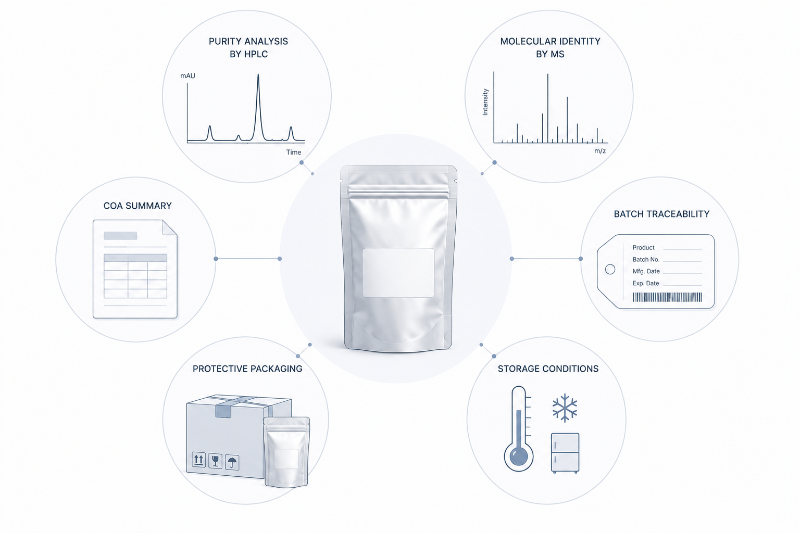
At MoxPeptide, we help buyers review peptide quality through several layers.
HPLC helps review the purity profile. MS helps confirm molecular identity. The COA summarizes the reported results. Batch references help connect the reports to the supplied material. Packaging and storage guidance help protect the product after dispatch.
We also consider the intended use.
Cosmetic brands often focus on formulation consistency, stable bulk supply, and documentation. Research laboratories often focus on sequence accuracy, purity, and analytical reports. Biotech innovators often need custom sequences, modifications, feasibility review, and scale-up planning.
The correct sourcing plan depends on the project.
Peptide Quality Review Framework
| Quality Area | What Buyers Should Check | Main Question |
|---|---|---|
| Identity | Product name, sequence, molecular formula, MS report | Is this the intended peptide? |
| Purity | HPLC report and target specification | Does the purity meet the project requirement? |
| Traceability | Batch number and test date | Can the product be linked to the relevant reports? |
| Consistency | Repeat-order records and agreed specification | Can future orders meet the same standard? |
| Packaging | Container type, seal, and quantity per pack | Will the peptide arrive in suitable condition? |
| Storage | Recommended temperature and handling | Can product stability be protected? |
We believe that quality is built through evidence, organization, and repeatable performance.
How Do Procurement Teams Reduce Supplier Risk?
No supply chain is completely risk-free. Yet a structured evaluation process can reduce many avoidable problems.
Procurement teams reduce peptide supplier risk through documentation review, qualification orders, realistic delivery planning, batch monitoring, clear communication, and repeat-order planning.
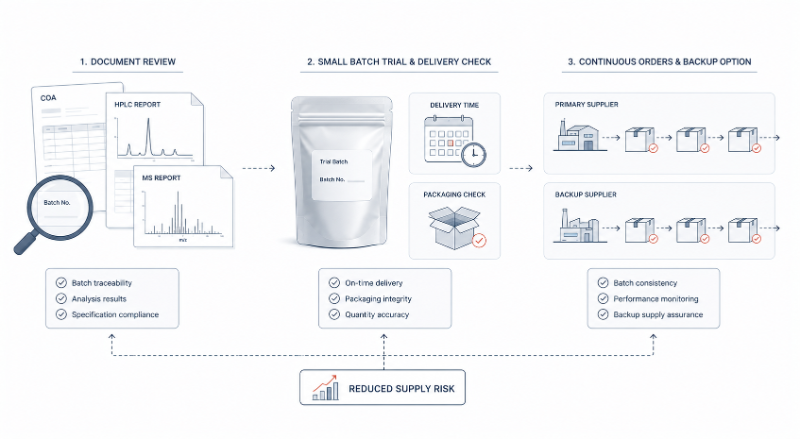
We recommend reviewing risk before a large order is placed.
Some risks appear in the documentation. A missing batch number may create traceability questions. A purity claim without supporting HPLC data may be difficult to review. Different batch references across documents may need clarification.
Other risks appear in logistics. A preparation timeline may be confused with shipping time. Packaging details may be unclear. A larger future order may require a different production plan.
At MoxPeptide, we coordinate these details with buyers before shipment. We help clarify available documents, packaging, preparation time, logistics options, and repeat-order planning.
This approach gives buyers a more complete view of the sourcing process.
Common Peptide Supplier Risks
| Risk | Warning Sign | How Procurement Teams Can Reduce It |
|---|---|---|
| Quality Risk | No supporting analytical reports | Request COA, HPLC, and MS data. |
| Traceability Risk | Missing or inconsistent batch references | Request linked batch records. |
| Delivery Risk | Unclear timelines | Confirm preparation time and shipping time separately. |
| Packaging Risk | No clear sealing or pack-size details | Review packaging information before shipment. |
| Communication Risk | Vague or inconsistent answers | Evaluate response quality before ordering. |
| Supply Risk | No repeat-order plan | Discuss future quantities and timelines early. |
A professional supply partner helps buyers identify these issues early and resolve them efficiently.
What Makes a Peptide Supplier Suitable for Long-Term Supply?
A supplier may complete one order successfully. A long-term supply partner must also support the next stage of the buyer’s project.
A long-term peptide supply partner should provide stable quality, organized documentation, flexible quantities, clear communication, realistic planning, and dependable repeat-order support.
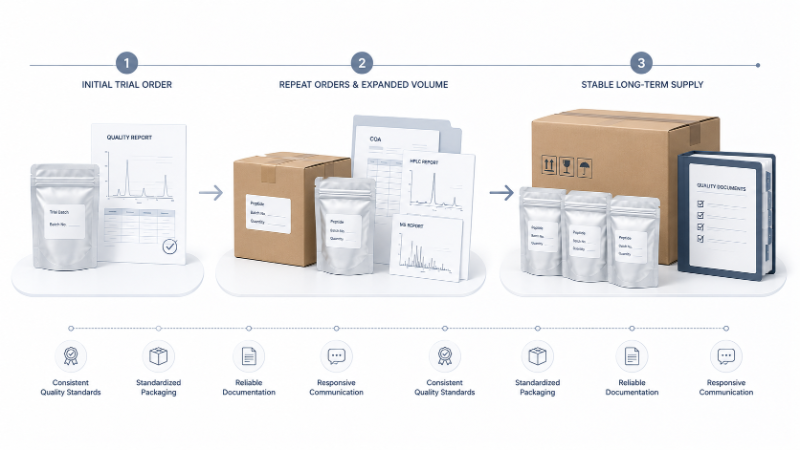
At MoxPeptide, we focus on long-term cooperation.
A cosmetic brand may begin with formulation testing and later move to wholesale supply. A research laboratory may begin with one peptide and later need several related products. A biotech company may begin with feasibility review and later require custom synthesis at a larger scale.
We help buyers move through these stages with greater clarity.
Based in Xi’an, China, we coordinate qualified manufacturing resources, analytical documentation, packaging, logistics, and international communication for global customers.
Long-Term Supply Indicators
| Indicator | Why It Matters |
|---|---|
| Consistent Documentation | Supports internal review and repeat purchasing |
| Stable Quality | Reduces project risk |
| Flexible Quantities | Supports samples, pilot orders, wholesale supply, and growth |
| Responsive Communication | Makes international sourcing easier |
| Realistic Planning | Reduces avoidable delays |
| Repeat-Order Support | Improves long-term supply continuity |
| Technical Coordination | Supports changing project requirements |
We build trust through clear information, reliable coordination, and consistent support across the entire sourcing process.
Conclusion
Procurement teams evaluate peptide suppliers through evidence, documentation, supply capability, communication, and long-term reliability.
At MoxPeptide, we help cosmetic brands, research laboratories, and biotech innovators source peptides with greater confidence through qualified manufacturing resources, analytical documentation, responsive communication, and dependable supply chain support from Xi’an, China.