How to Evaluate a Peptide Supplier Before Bulk Purchasing?
A supplier may look reliable on paper. Yet one failed batch can delay production, damage formulations, and cost thousands in lost time and inventory.
To evaluate a peptide supplier before bulk purchasing, buyers should verify analytical data, manufacturing consistency, documentation quality, communication speed, and impurity control. The best suppliers provide transparent COA, HPLC, and MS reports while demonstrating batch-to-batch reliability and long-term supply stability.

I have spoken with many procurement teams that focused only on price during supplier selection. Most problems appeared months later. The real risk was not the quoted price. The real risk was hidden inside the material quality, documentation accuracy, and supply chain reliability.
What Documents Should a Professional Peptide Supplier Provide?
Many suppliers claim high purity. Many suppliers claim GMP standards. Yet some buyers never ask for the documents that prove these claims.
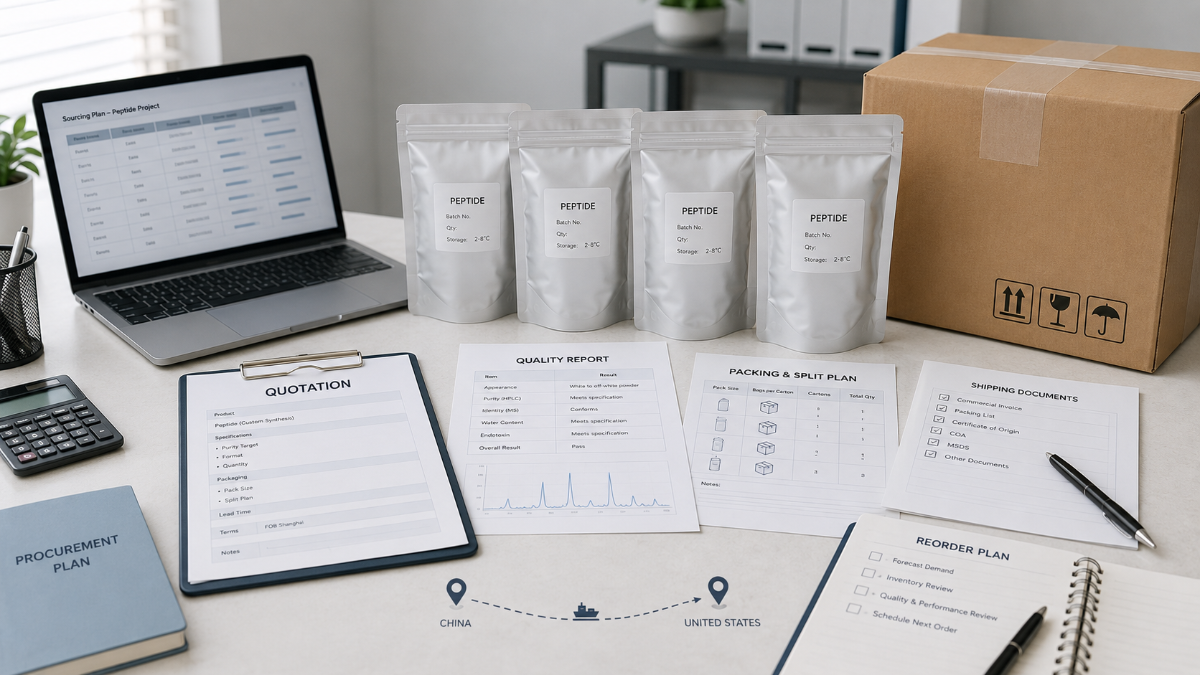
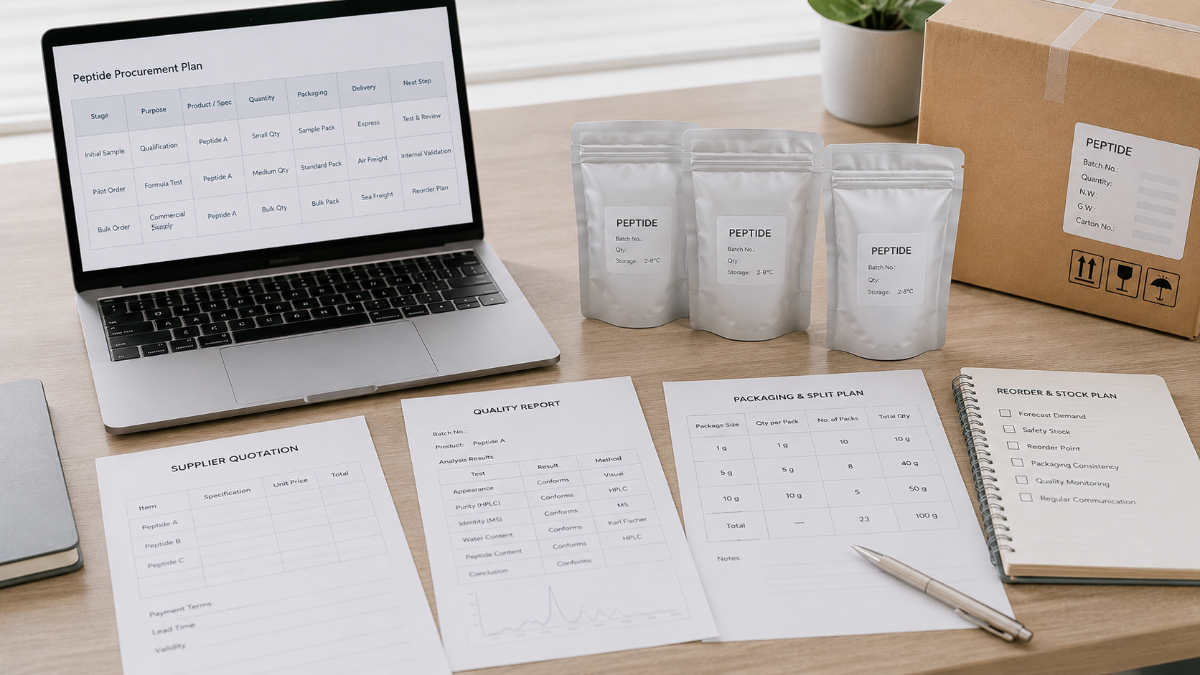
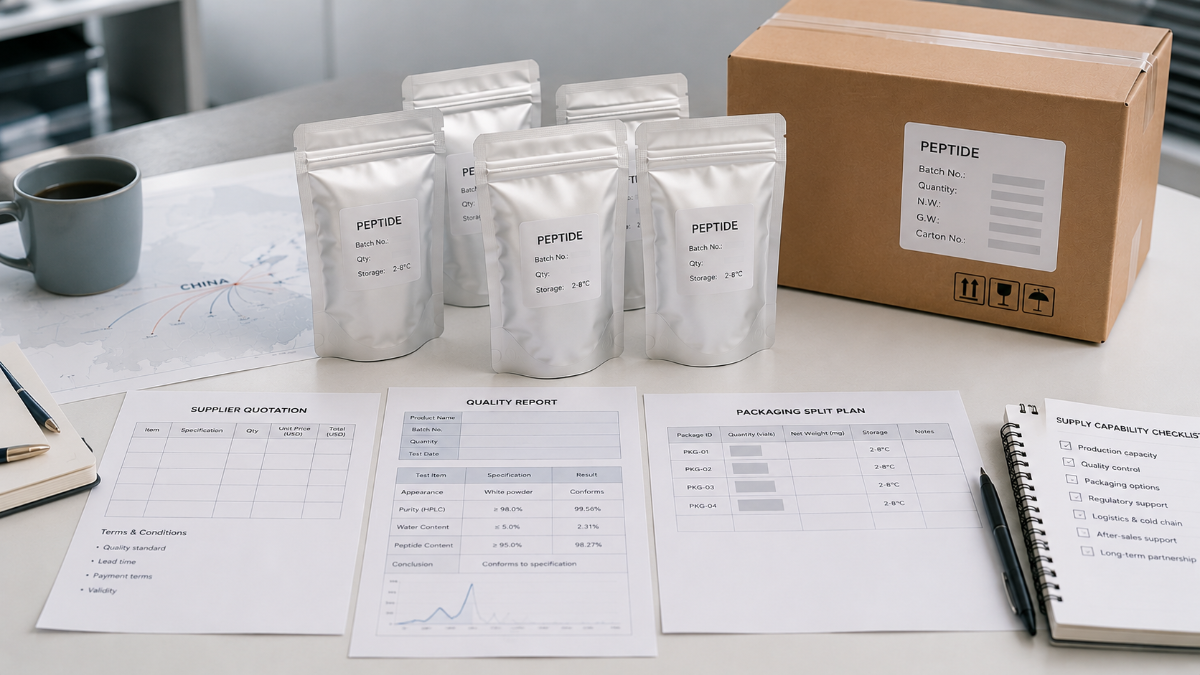
A professional peptide supplier should provide a Certificate of Analysis (COA), HPLC chromatogram, Mass Spectrometry (MS) report, specification sheet, and batch information. These documents allow buyers to verify identity, purity, and manufacturing consistency before purchasing.

The first thing I review is documentation quality. I often find that buyers focus on the purity percentage shown on a COA. That number alone tells very little.
Why Documentation Matters More Than Marketing Claims
Many suppliers use identical wording across their COAs. Some reports are generated from templates. Some HPLC charts are reused across multiple products. A buyer who only checks the purity number may never notice these issues.
I prefer to compare the entire documentation package.
| Document | Purpose | Common Red Flag |
|---|---|---|
| COA | Product specifications | Missing batch number |
| HPLC Report | Purity verification | Low-resolution image |
| MS Report | Identity confirmation | Missing molecular weight match |
| Specification Sheet | Product requirements | Generic template language |
| Batch Record | Traceability | Not available upon request |
A supplier who can quickly provide complete documentation often has stronger internal quality systems.
I also pay attention to response speed. Reliable suppliers usually know exactly where their analytical reports are stored. Poor suppliers often spend days searching for documents that should be immediately available.
Another point many buyers overlook is analytical transparency. A supplier who willingly shares raw chromatograms usually has nothing to hide. A supplier who only shares a purity percentage may be hiding something important.
Is HPLC Purity Alone Enough to Judge Peptide Quality?
Many buyers use HPLC purity as the primary purchasing criterion. This approach creates serious blind spots.
No, HPLC purity alone is not enough. HPLC measures certain impurities, but it does not always reveal structural isomers, sequence errors, residual reagents, or counterion content that may affect performance and stability.

I often see procurement specifications requiring “≥99% purity.” That sounds strict. Yet I have seen two different suppliers both report 99% purity while delivering very different product performance.
The Hidden Risks Behind High Purity Numbers
A peptide can achieve excellent HPLC results while still containing issues that affect real-world applications.
One example involves trifluoroacetic acid (TFA) residues. TFA is commonly used during peptide synthesis and purification. Excessive residual TFA may influence formulation stability and sometimes contribute to discoloration in cosmetic products.
Another overlooked issue involves structural isomers. Standard HPLC methods may not always separate these compounds effectively.
| Quality Factor | Detected by Standard HPLC? | Potential Impact |
|---|---|---|
| Purity Percentage | Yes | General quality assessment |
| Molecular Identity | No | Requires MS confirmation |
| Structural Isomers | Sometimes | Reduced biological activity |
| TFA Residues | Usually No | Stability concerns |
| Counterion Content | Usually No | Actual active content differs |
| Sequence Errors | Not Always | Performance failure |
I once reviewed two GHK-Cu batches from different suppliers. Both showed nearly identical purity values. One batch maintained formulation color stability for months. The other gradually darkened. The difference was not visible from the HPLC purity percentage alone.
This is why I always recommend evaluating the entire analytical package rather than focusing on a single number.
How Can Buyers Assess Long-Term Supplier Reliability?
A supplier may perform well during sampling. The real challenge begins when production scales from grams to kilograms.
Buyers should assess manufacturing capacity, communication quality, supply consistency, technical expertise, and willingness to support future scale-up requirements. Long-term reliability matters more than short-term pricing advantages.

Many purchasing decisions are made based on the first quotation. I believe this is one of the biggest mistakes in peptide sourcing.
Supply Chain Stability Is the Real Product
The peptide itself is only part of what a buyer purchases.
The buyer is also purchasing:
- Future production capacity
- Batch consistency
- Technical support
- Documentation reliability
- Shipping execution
- Communication efficiency
A supplier may offer a low price today. Yet if they cannot maintain consistency across future batches, the actual cost becomes much higher.
| Evaluation Area | Questions to Ask |
|---|---|
| Manufacturing Capacity | Can they scale from grams to kilograms? |
| Batch Consistency | Do they maintain historical records? |
| Technical Support | Can they answer formulation questions? |
| Documentation | Are reports provided proactively? |
| Communication | How quickly do they respond? |
| Logistics | What shipping methods are available? |
I also recommend requesting samples from multiple production batches whenever possible. A single sample only shows one moment in time. Multiple batches reveal whether a supplier can deliver consistent quality over the long term.
At MoxPeptide, I view our role as more than simply supplying peptide materials. We act as the bridge between global buyers and trusted manufacturing resources in China’s biotechnology ecosystem. My goal is always to reduce uncertainty. Buyers need confidence that the next batch will perform exactly like the last one. That level of consistency creates real supply chain value.
Conclusion
The best peptide supplier is not always the cheapest supplier. The right partner combines analytical transparency, consistent quality, reliable communication, and long-term supply stability that buyers can depend on.