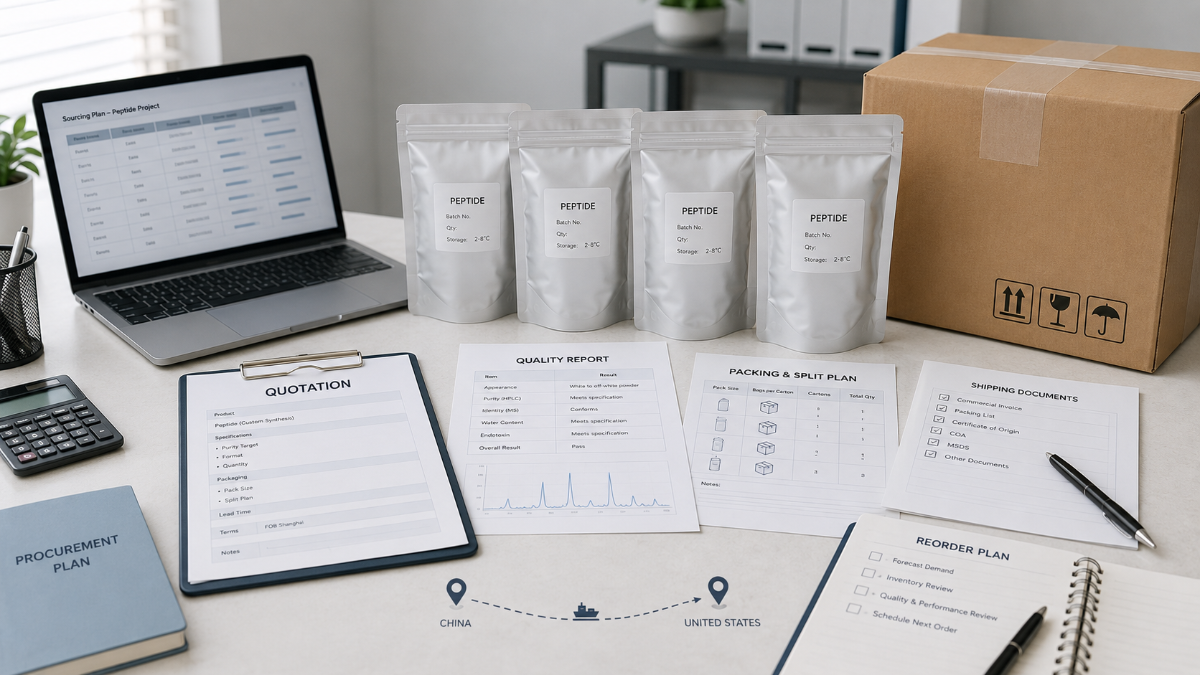
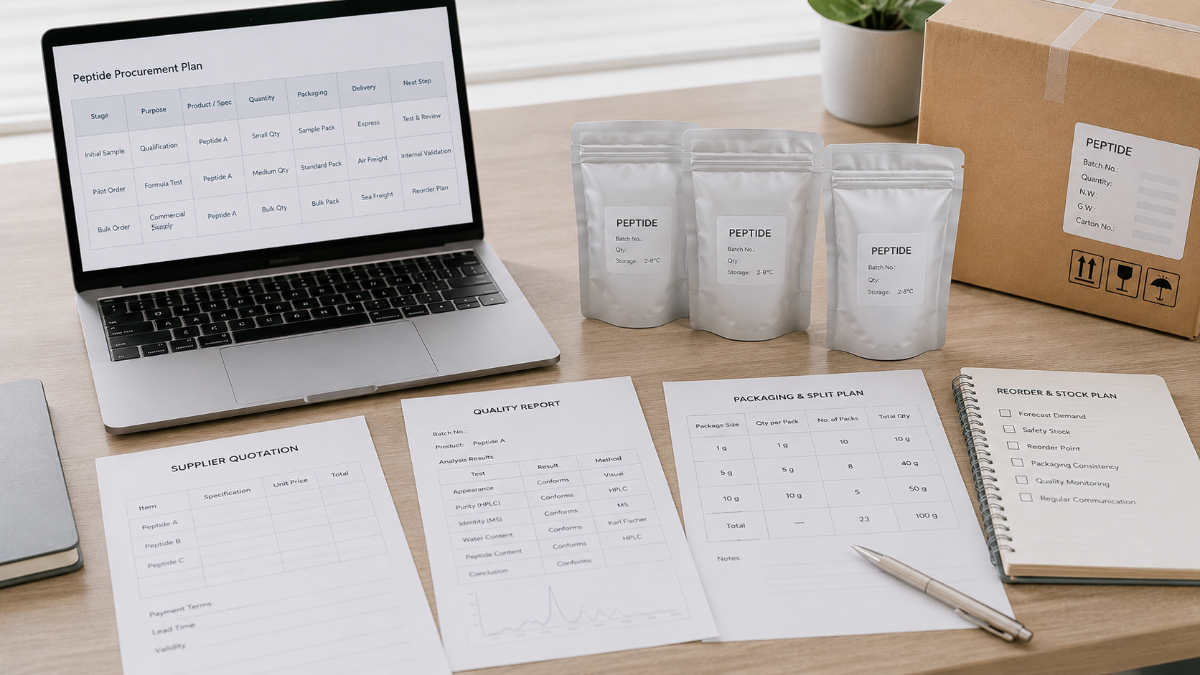
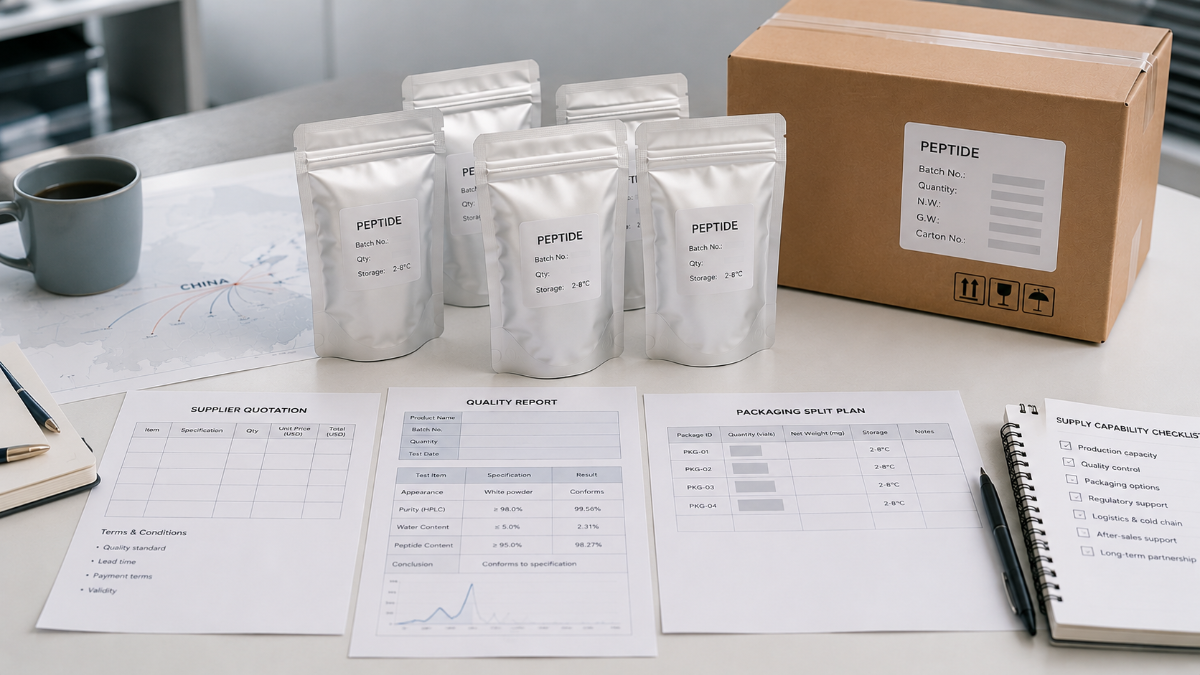
What Buyers Should Know About Bulk Peptide Shipping?
Bulk peptide shipping can look like a simple logistics task. Yet unsuitable packaging, unclear temperature requirements, or incomplete documents can turn a routine order into an expensive delay.
Before shipping peptides in bulk, we recommend confirming product form, storage requirements, packaging, transit time, customs documents, carrier rules, destination-market requirements, and a plan for possible delays.
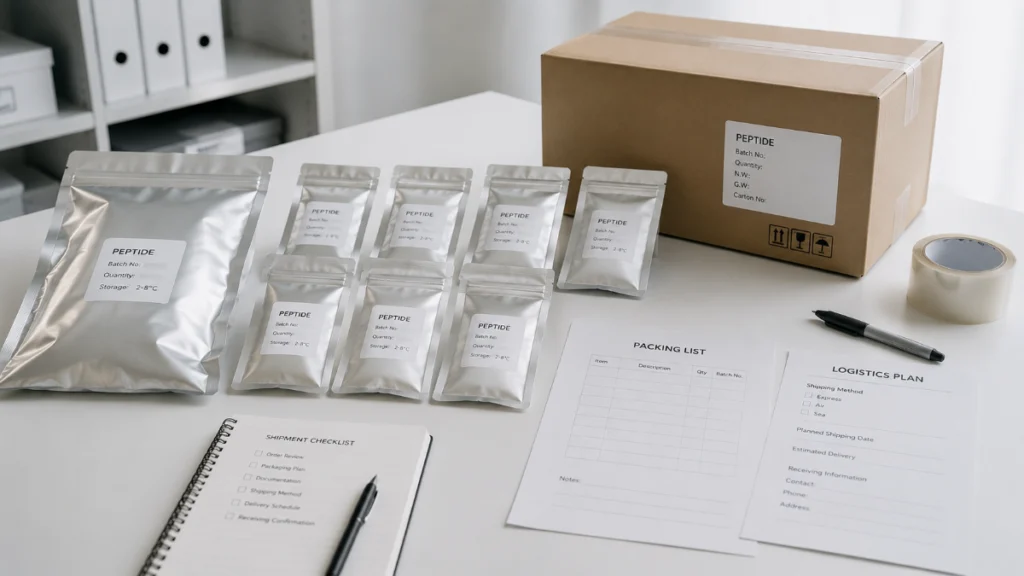
At MoxPeptide, we work with cosmetic brands, research laboratories, distributors, and biotech companies that source peptides from China.
Many buyers begin by asking one direct question:
How fast can you ship?
We understand why this matters. Delivery speed affects formulation schedules, internal testing, inventory planning, and customer commitments.
Yet speed should not be the only question.
A peptide shipment should arrive in a condition that supports the buyer’s intended use. The packaging should fit the product form. The documents should match the order. The shipping method should reflect the route, transit time, storage guidance, and destination requirements.
A small trial order may be relatively easy to manage. A bulk order creates a different level of responsibility. Larger quantities may need split packaging, clearer receiving procedures, more careful inventory planning, and a stronger delay buffer.
Based in Xi’an, China, MoxPeptide helps global buyers coordinate qualified manufacturing resources, available analytical documentation, packaging, logistics, international communication, and repeat-order planning.
We do not treat shipping as the final step after production.
We treat shipping as part of the complete sourcing process.
How Should Peptides Be Shipped?
There is no single shipping method that fits every peptide, quantity, route, or application.
Peptides should be shipped according to product-specific storage guidance, physical form, route duration, packaging needs, carrier requirements, and destination-market rules. Buyers should confirm these details before dispatch.
We recommend avoiding one common mistake:
Assuming that every peptide shipment needs the same temperature conditions.
Some peptides may be supplied as lyophilized powder. Others may be supplied in a different format. A product may require temperature-controlled transport. Another product may be suitable for a validated room-temperature shipping plan.
The correct method depends on the product and the route.
Lyophilized powder may provide practical handling advantages for some projects. Yet lyophilized form does not automatically mean that every shipment can travel under any condition.
The buyer should still ask for product-specific storage guidance.
Peptide Shipping Decision Framework
| Question | Why It Matters |
|---|---|
| What is the physical form of the peptide? | Lyophilized powder, solution, and other formats may require different handling plans. |
| What storage conditions are recommended? | The shipping plan should support product stability. |
| How long will the shipment remain in transit? | A longer route may require a larger delay buffer. |
| Could customs clearance extend the timeline? | International shipments should not be planned only around the fastest possible route. |
| Does the shipment require refrigerated or frozen transport? | The packaging and carrier process may change. |
| Will dry ice or another coolant be used? | Dry ice introduces additional packaging, marking, and carrier requirements. |
| How much product is being shipped? | Bulk quantities may need split packaging and stronger receiving procedures. |
| What does the destination market require? | Product classification and import requirements may affect the shipment plan. |
At MoxPeptide, we confirm these details before dispatch.
We coordinate with buyers on product format, quantity, packaging, preparation time, shipping options, and available documentation.
Our goal is to choose a practical route rather than rely on a generic shipping answer.
Should Peptides Be Shipped at Room Temperature, Refrigerated, or Frozen?
Temperature planning should begin with product-specific guidance, not assumptions.
Peptides may be shipped using validated room-temperature, refrigerated, or frozen conditions depending on the product form, stability needs, transit time, and route risk. Buyers should confirm the correct plan before shipment.
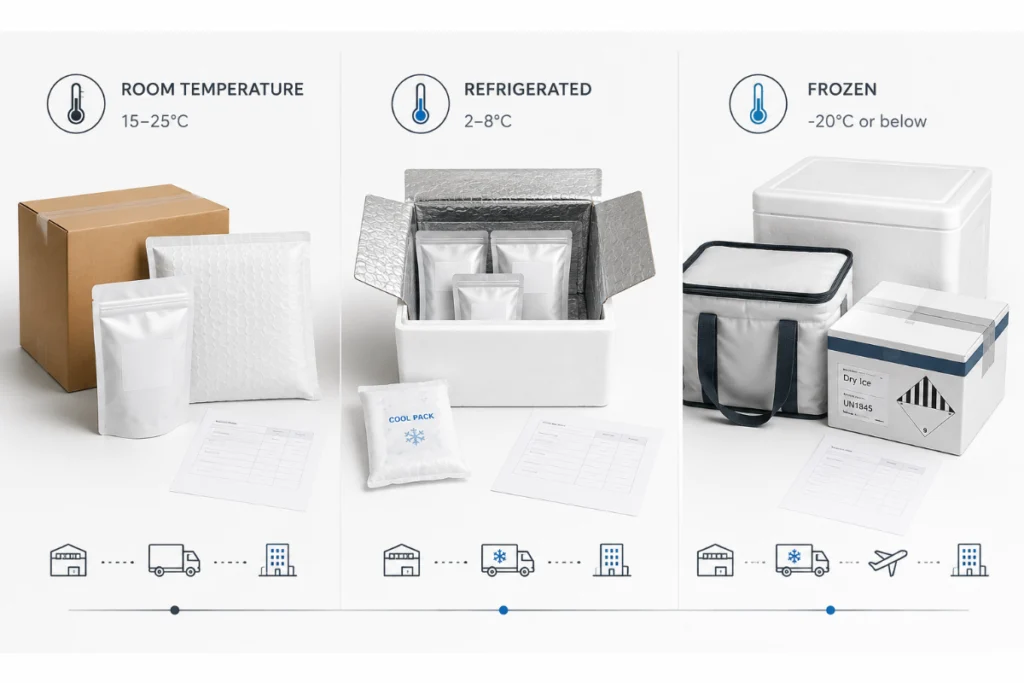
We recommend separating storage conditions from shipping conditions.
These two ideas are related, but they are not always identical.
A product may have a recommended long-term storage temperature. The supplier and buyer still need to determine the appropriate shipping plan for the expected transit period.
A route with a short, predictable transit time may create one type of plan.
A route with multiple customs checkpoints, extreme weather, weekends, or public holidays may require a different plan.
Common Shipping Approaches
| Shipping Approach | When It May Be Considered | What Buyers Should Confirm |
|---|---|---|
| Validated Room-Temperature Shipping | When product-specific guidance supports it | Route duration, seasonal conditions, packaging, and delay buffer |
| Refrigerated Shipping | When the material requires controlled cool conditions | Target temperature range, insulation, coolant, carrier capability, and transit time |
| Frozen Shipping | When product-specific guidance requires lower temperatures | Coolant method, packaging, dry-ice rules, carrier approval, and delay planning |
| Temperature-Monitored Shipping | When the buyer needs more visibility during transit | Data logger, acceptable range, review process, and action plan for excursions |
We do not recommend choosing the most complex method automatically.
A more expensive shipping method is not always a better method.
The better method is the one that fits the product, route, and buyer’s internal requirements.
For buyers considering refrigerated shipping, carrier solutions vary. For example, FedEx provides an official overview of its refrigerated and cold shipping options.
At MoxPeptide, we coordinate shipping options based on the real project.
We also encourage buyers to plan for a realistic transit window rather than the best-case scenario alone.
What Should Buyers Know About Shipping Peptides With Dry Ice?
Dry ice can be useful for some temperature-sensitive shipments. Yet it should not be treated as ordinary packing material.
Dry ice is regulated as a dangerous good. When it is used, the shipper should confirm packaging, ventilation, marking, labeling, carrier acceptance, and route-specific requirements before dispatch.
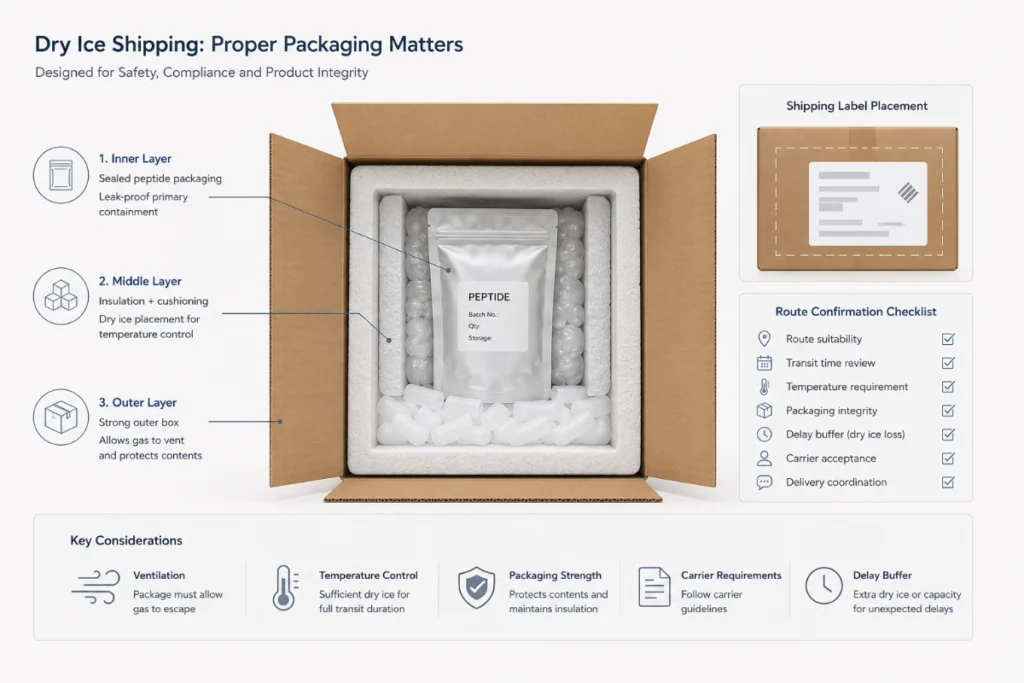
We recommend using dry ice only when it fits the product-specific shipping plan.
Dry ice is solid carbon dioxide. It sublimates into gas during transit. This means that the package must be prepared correctly.
A hermetically sealed package can create pressure risk as carbon dioxide gas builds up.
The official UPS guide explains that dry ice can be hazardous if it is not handled correctly and that packaging must allow proper venting: UPS: Shipping With Dry Ice
FedEx also provides an official guide for businesses shipping with dry ice: FedEx: How to Safely Ship With Dry Ice
The International Air Transport Association provides a current acceptance checklist for shipments containing dry ice: IATA: Acceptance Checklist for Dry Ice
Dry-Ice Shipping Questions Buyers Should Ask
| Question | Why It Matters |
|---|---|
| Is dry ice actually required for this peptide? | Dry ice should support a real product requirement. |
| Which carrier will handle the shipment? | Carrier acceptance rules may differ. |
| Does the carrier accept dry ice on this route? | Route and service restrictions may apply. |
| How much dry ice will be used? | The quantity affects packing, marking, booking, and transit planning. |
| Can the outer package release carbon dioxide gas safely? | Dry ice should not be placed in a hermetically sealed package. |
| Which markings and labels are required? | Dry ice shipments require correct identification. |
| Is trained handling required? | Carrier and dangerous-goods procedures may apply. |
| What happens if customs clearance takes longer than expected? | The coolant plan should include a realistic delay buffer. |
We also recommend confirming whether dry ice can be replenished during a delay.
The answer depends on the carrier, route, and service level.
At MoxPeptide, we help buyers clarify these details before dispatch. We believe that the correct shipping method should be planned before the product leaves the warehouse.
How Should Bulk Peptides Be Packaged?
Bulk packaging should protect the peptide and support the buyer’s receiving workflow.
Bulk peptides should be packaged according to product form, quantity, storage requirements, handling needs, and the buyer’s internal process. Split packaging may be useful for inventory control and repeated use.
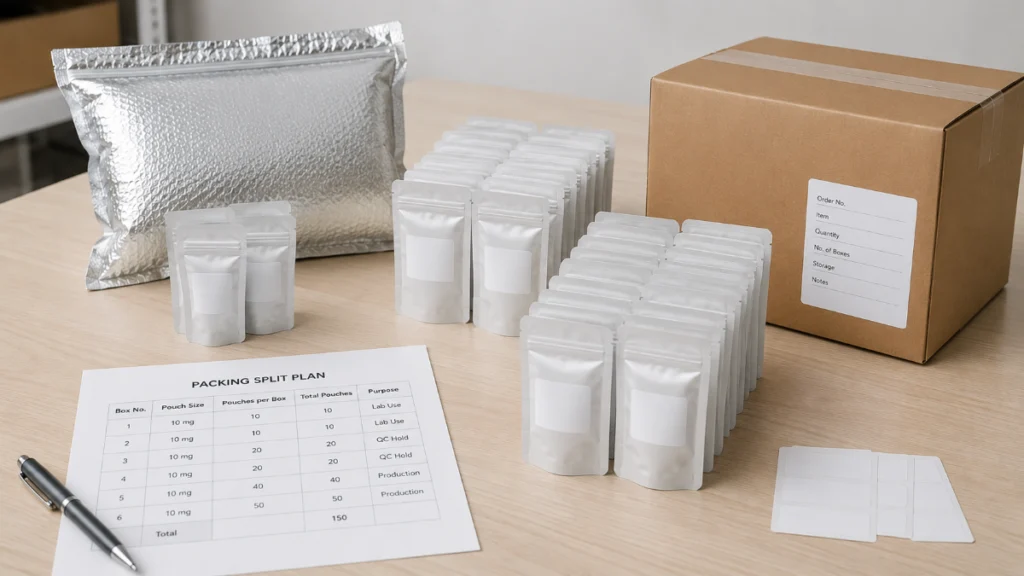
We often see buyers focus on total quantity first.
Yet the quantity per container can be just as important.
A buyer ordering 100 grams may not want one container holding the entire amount. Several smaller sealed packs may fit the workflow better.
A cosmetic brand may prefer quantities that match formulation batches.
A research laboratory may prefer smaller packs for controlled internal use.
A distributor may need pack sizes that support inventory planning.
A biotech company may need separate packs for different development stages.
Bulk Peptide Packaging Checklist
| Packaging Area | What Buyers Should Confirm |
|---|---|
| Primary Container | What container will directly hold the peptide? |
| Sealing Method | How will the container be sealed and protected? |
| Quantity Per Pack | Will the total order be divided into smaller sealed packs? |
| Labeling | What product, batch, quantity, and storage information will appear on the label? |
| Secondary Packaging | How will individual containers be grouped and protected? |
| Outer Packaging | Is the outer package suitable for the planned shipping route? |
| Temperature Protection | Does the package support the selected temperature plan? |
| Receiving Workflow | Can the buyer inspect and store the shipment efficiently after arrival? |
We recommend discussing split packaging before the quotation is finalized.
This avoids misunderstandings later.
At MoxPeptide, we coordinate packaging based on the buyer’s quantity, storage needs, receiving process, and repeat-order plan.
We believe that packaging should reduce work for the buyer after delivery.
What Documents Should Accompany a Bulk Peptide Shipment?
A shipment can arrive physically while still creating internal delays if the paperwork is incomplete or unclear.
Bulk peptide shipments should include appropriate commercial, product, quality, safety, and logistics records based on the product classification, destination, carrier, and buyer requirements.
We recommend discussing the documentation package before shipment.
The buyer may need documents for internal approval, customs clearance, receiving inspection, storage planning, or repeat-order records.
A commercial invoice and packing list help explain the shipment.
A COA provides a reported quality summary.
HPLC and MS reports may support analytical review whenever applicable.
An SDS may provide useful handling, storage, and transportation information.
The U.S. Occupational Safety and Health Administration explains that an SDS includes information about chemical properties, hazards, protective measures, and precautions for handling, storing, and transporting chemicals: OSHA: Hazard Communication Standard — Safety Data Sheets
Common Bulk Peptide Shipment Documents
| Document | What It Helps Buyers Review |
|---|---|
| Commercial Invoice | Product description, quantity, declared value, and transaction details |
| Packing List | Number of packages, quantity per pack, and shipment structure |
| COA | Reported quality summary |
| HPLC Report | Purity profile whenever applicable |
| MS Report | Molecular identity support whenever applicable |
| SDS | Handling, storage, and safety information |
| Product Specification | Agreed product requirements |
| Packaging Details | Container type, sealing method, and pack size |
| Tracking Information | Shipment status and route visibility |
| Carrier Documents | Transport records required for the selected route |
| Dry-Ice Documentation or Marking | Required when dry ice is used |
| Import-Related Records | Required based on product classification and destination market |
We do not believe that the best shipment is the one with the largest number of attachments.
The best shipment is the one with a clear documentation package that matches the product and route.
At MoxPeptide, we help buyers understand which available records fit the order and which details still need confirmation.
How Should Buyers Plan for Customs Clearance?
International shipping should be planned around the complete route, not only the flight time.
Buyers should confirm product classification, shipment description, required documents, importer responsibilities, customs procedures, and a realistic clearance buffer before dispatch.
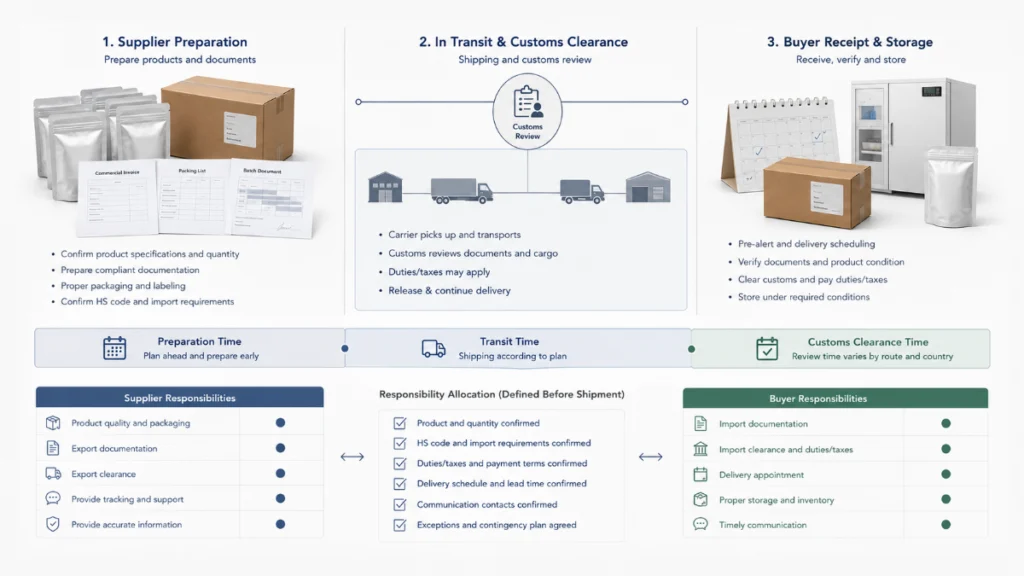
We recommend separating three time periods:
- Preparation time
- Transport time
- Clearance and final-delivery time
These periods are different.
A supplier may need time to prepare the product, finalize documentation, pack the order, and arrange dispatch.
The carrier may provide an estimated transit time.
Customs review can then add another layer of uncertainty.
This matters even more when the shipment uses temperature-controlled packaging.
A shipping plan should not assume that customs clearance will always happen immediately.
For U.S. imports, the FDA explains that all products regulated by the agency must meet the same requirements whether they are imported or produced domestically: FDA Import Program
The FDA also explains that imported FDA-regulated products are reviewed when they are offered for entry into the United States: FDA Import Process
U.S. Customs and Border Protection provides general guidance for commercial importers: CBP: Basic Importing and Exporting
CBP also provides practical information for first-time importers and exporters: CBP: Tips for New Importers and Exporters
Customs Planning Questions
| Question | Why It Matters |
|---|---|
| How should the product be described? | Clear product descriptions reduce avoidable confusion. |
| Which classification applies? | Classification can affect the import process. |
| Who is the importer of record? | Responsibilities should be clear before dispatch. |
| Does the buyer need a customs broker? | A broker may help manage the clearance process. |
| Which documents should be prepared? | Missing records can create delays. |
| Could the shipment be held for review? | Temperature-sensitive shipments need a delay plan. |
| Is the receiving team ready? | The buyer should be prepared to inspect and store the shipment promptly. |
CBP explains that importers are not always legally required to use a customs broker, although many choose to do so for convenience. CBP-licensed customs brokers can assist with customs business on behalf of importers: CBP: Customs Broker Information
At MoxPeptide, we coordinate available shipping information and documentation with buyers before dispatch.
We also recommend that buyers confirm project-specific import requirements with qualified advisors, customs brokers, and relevant authorities.
Who Is Responsible for Shipping Risk and Import Formalities?
A shipment can become confusing when the buyer and seller have different expectations about responsibility.
Buyers and suppliers should agree on shipping responsibilities, costs, insurance, risk transfer, import formalities, and delivery terms before the order is confirmed.
We recommend discussing the commercial shipping term early.
A quotation should not leave the buyer guessing about who arranges transport, who pays freight, when risk transfers, or who handles import clearance.
The International Chamber of Commerce publishes the Incoterms® rules for international and domestic sale contracts. These rules help clarify the tasks, costs, and risks involved in delivery: ICC: Incoterms® Rules
Shipping Responsibility Questions
| Question | Why It Matters |
|---|---|
| Which Incoterms® rule applies? | The commercial agreement should be clear. |
| Who arranges the carrier? | The buyer and supplier should know who books transport. |
| Who pays the freight cost? | The quotation should explain whether freight is included. |
| When does risk transfer? | The buyer should understand the agreed delivery point. |
| Who handles export formalities? | Responsibilities should be confirmed before dispatch. |
| Who handles import formalities? | The buyer should prepare for destination requirements. |
| Is insurance included or separate? | Bulk shipments may need a clearer risk plan. |
| Who will manage a delay or exception? | A defined contact reduces confusion during transit. |
At MoxPeptide, we aim to explain the shipping plan clearly before the order is finalized.
We believe that a buyer should understand the complete route and the responsibilities on both sides.
Do Buyers Need a License to Sell or Import Peptides?
There is no single universal license that applies to every peptide shipment or business model.
Licensing, registration, approval, and import requirements depend on the peptide’s intended use, product classification, marketing claims, business activity, and destination market.
We recommend treating regulatory fit as a project-specific question.
A cosmetic ingredient raises different questions from a finished skincare product.
A research material raises different questions from a finished product marketed for human use.
A product marketed as a drug raises a different set of requirements.
The intended use and marketing claims matter.
For the United States, the FDA explains how intended use can affect whether a product is considered a cosmetic, a drug, or both: FDA: Is It a Cosmetic, a Drug, or Both?
The FDA also explains that cosmetics and cosmetic ingredients generally do not require premarket approval, except for color additives: FDA Authority Over Cosmetics
The Modernization of Cosmetics Regulation Act of 2022 (MoCRA) introduced additional requirements for parts of the U.S. cosmetics industry.
Regulatory Questions Buyers Should Ask
| Question | Why It Matters |
|---|---|
| What is the intended use? | Intended use may affect product classification. |
| Is the buyer purchasing an ingredient or a finished product? | Different business models may involve different requirements. |
| Which country will receive the shipment? | Rules vary across destination markets. |
| What claims will appear in marketing materials? | Claims may affect the regulatory pathway. |
| Will the buyer import, resell, distribute, or formulate the material? | Business activities may affect the review process. |
| Which documents are available? | Internal teams may need supporting records. |
| Does the buyer need professional advice? | Qualified advisors should review project-specific questions. |
At MoxPeptide, we ask buyers to clarify the intended use and destination market early.
We coordinate available product information and documentation.
We also recommend that buyers confirm regulatory suitability with qualified advisors and relevant authorities for their specific application.
What Should Buyers Ask a Peptide Vendor Before Shipping?
A clear pre-shipment conversation can prevent avoidable problems.
Before shipping peptides, buyers should ask about product form, quantity, packaging, storage guidance, temperature conditions, preparation time, carrier, transit estimate, customs documents, tracking, and delay planning.
We recommend sending a structured checklist.
This makes it easier to compare suppliers and identify missing details.
Bulk Peptide Pre-Shipment Checklist
- What is the exact peptide name, sequence, and quantity?
- What physical form will be shipped?
- What storage conditions are recommended?
- Which shipping conditions are appropriate for the expected route?
- Is room-temperature shipping suitable for this product and transit window?
- Is refrigerated or frozen shipping required?
- Will dry ice or another coolant be used?
- How much product will be placed in each container?
- Can the order be divided into smaller sealed packs?
- What information will appear on each label?
- Which documents will be provided before dispatch?
- Will COA, HPLC, MS, and SDS records be available whenever applicable?
- What is the preparation time before dispatch?
- Which carrier and service level will be used?
- What is the estimated transit time?
- What delay buffer has been included in the packaging plan?
- Who will coordinate customs questions?
- Will tracking information be provided?
- Who should the buyer contact if the shipment is delayed?
- How should the buyer inspect and store the shipment after delivery?
At MoxPeptide, we welcome these questions.
They help us coordinate a shipping plan that fits the buyer’s project.
How Should Buyers Receive and Inspect a Bulk Peptide Shipment?
Shipping does not end when the package reaches the buyer’s address. The receiving team should be ready to inspect and store the shipment promptly.
After delivery, buyers should inspect the outer package, verify labels and quantities, review shipment documents, check packaging condition, follow storage guidance, and record any issue quickly.
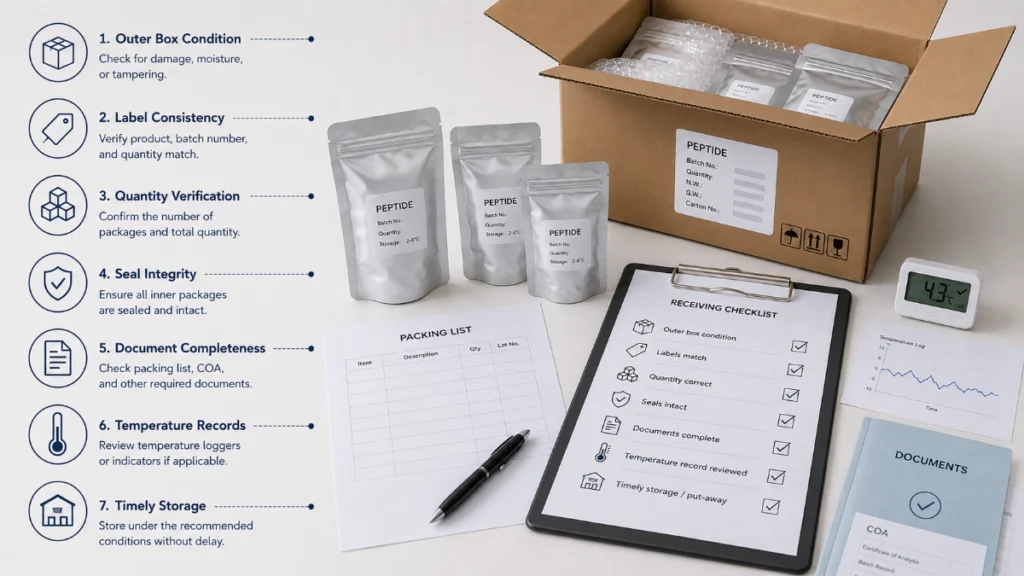
We recommend preparing the receiving team before dispatch.
This is especially important for temperature-controlled shipments.
The buyer should know when the shipment is expected.
The receiving team should know where the package will be stored.
The buyer should also know what to do if the outer packaging is damaged or the shipment arrives later than expected.
Receiving Inspection Checklist
| Inspection Area | What Buyers Should Check |
|---|---|
| Outer Packaging | Is the package intact and free from obvious damage? |
| Labels | Do the product name, batch number, quantity, and storage instructions match the order? |
| Quantity | Does the received pack structure match the packing list? |
| Seals | Are the containers properly sealed? |
| Documents | Are the expected records available and organized? |
| Temperature Evidence | Is monitoring data available when required? |
| Storage | Can the product be stored promptly under the recommended conditions? |
| Exceptions | Has any damage, delay, or discrepancy been documented quickly? |
At MoxPeptide, we aim to provide buyers with clear shipping information before dispatch.
This helps receiving teams prepare in advance.
What Are the Most Reputable Peptide Vendors?
There is no single supplier that fits every peptide, buyer, route, and application.
The most reputable peptide vendors provide suitable products, relevant analytical documentation, practical packaging, clear shipping plans, responsive communication, and dependable repeat-order support.
We recommend evaluating vendors based on execution.
A low quotation can be attractive.
Yet business buyers also need to know whether the supplier can coordinate the complete process.
Reputable Peptide Vendor Shipping Checklist
| Indicator | Why It Matters |
|---|---|
| Product-Specific Guidance | The shipping plan should fit the actual peptide. |
| Clear Documentation | Buyers need records for internal review and receiving. |
| Practical Packaging | The shipment should fit the buyer’s handling process. |
| Realistic Timelines | Buyers need a plan that includes preparation and clearance. |
| Carrier Coordination | The supplier should understand route and service options. |
| Dry-Ice Awareness | Regulated coolant should be managed correctly when used. |
| Customs Awareness | Cross-border shipping requires accurate planning. |
| Responsive Communication | Delays and questions should be handled quickly. |
| Repeat-Order Planning | Future shipments should become more predictable over time. |
At MoxPeptide, we build our service around these requirements.
We coordinate qualified manufacturing resources, available analytical documentation, packaging, logistics options, and international communication from Xi’an, China.
We do not treat shipping as an afterthought.
We treat it as an important part of supply reliability.
How Can Buyers Reduce Bulk Peptide Shipping Risk?
No international shipment is completely risk-free. Yet many avoidable problems can be reduced through better preparation.
Buyers can reduce bulk peptide shipping risk by confirming product-specific conditions, using suitable packaging, planning for delays, preparing accurate documents, clarifying responsibilities, and keeping communication active until delivery.
We recommend using a risk checklist before dispatch.
A small question asked early can prevent a larger problem later.
Common Shipping Risks and Practical Responses
| Risk | Warning Sign | Practical Response |
|---|---|---|
| Temperature Risk | No clear shipping condition | Confirm product-specific storage guidance and route plan. |
| Delay Risk | Packaging only fits the fastest estimated transit time | Add a realistic clearance and weekend buffer. |
| Packaging Risk | Total quantity packed without discussing buyer workflow | Confirm pack size and split-packaging needs. |
| Documentation Risk | Missing invoice, packing list, or product records | Review the documentation package before dispatch. |
| Dry-Ice Risk | No clear carrier confirmation or labeling plan | Confirm carrier acceptance and regulated-goods requirements. |
| Customs Risk | Unclear product description or importer responsibility | Confirm classification and seek broker advice where needed. |
| Receiving Risk | Buyer is not prepared for delivery | Share tracking details and receiving instructions early. |
| Communication Risk | No clear contact person | Define a responsible contact before shipment. |
At MoxPeptide, we focus on reducing these risks through planning and communication.
A reliable shipment is not created by one action.
It is created by connecting product information, documentation, packaging, logistics, customs awareness, and buyer readiness.
Useful Official Resources for Bulk Peptide Shipping
The following official resources can support internal review for cross-border peptide shipments:
| Official Resource | When It Is Useful |
|---|---|
| FDA: Import Program | Explains that imported FDA-regulated products must meet applicable U.S. requirements. |
| FDA: Importing FDA-Regulated Products | Provides an overview of the FDA import process. |
| FDA: FDA Import Process | Helps buyers understand FDA import review. |
| FDA: Is It a Cosmetic, a Drug, or Both? | Explains how intended use and claims may affect product classification. |
| FDA: Authority Over Cosmetics | Explains how cosmetics and cosmetic ingredients are regulated in the United States. |
| FDA: Modernization of Cosmetics Regulation Act of 2022 | Explains the expanded U.S. cosmetics framework. |
| CBP: Basic Importing and Exporting | Provides general customs information for commercial importers. |
| CBP: Tips for New Importers and Exporters | Provides practical guidance for new importers. |
| CBP: Becoming a Customs Broker | Explains the role of CBP-licensed customs brokers. |
| OSHA: Safety Data Sheets | Explains the information included in an SDS. |
| IATA: Acceptance Checklist for Dry Ice | Helps buyers review dry-ice shipping requirements. |
| FedEx: How to Safely Ship With Dry Ice | Provides carrier guidance for dry-ice shipments. |
| FedEx: Refrigerated and Cold Shipping | Provides an overview of temperature-controlled shipping options. |
| UPS: Shipping With Dry Ice | Explains practical dry-ice handling and packaging considerations. |
| ICC: Incoterms® Rules | Helps buyers and sellers clarify tasks, costs, and risks during delivery. |
These resources are useful starting points. They do not replace product-specific stability review, carrier confirmation, customs advice, or market-specific legal and regulatory guidance.
Conclusion
Bulk peptide shipping requires more than choosing the fastest courier.
At MoxPeptide, we help global buyers coordinate product-specific shipping conditions, packaging, documentation, logistics, customs awareness, and repeat-order planning so that peptide sourcing can move forward with greater confidence.